Ukraine Update

Overview
The attacks on Russian logistics from Luhansk to Melitopol continues. For all the known attacks on trucks, even more are conducted on warehouses and depots. There are an unknown number of attacks that haven’t been released publicly. Understandably, predictably, more trucks are avoiding the main highways and taking smaller roads. Even without being attacked, their movement is slowed because the roads don’t support high speed travel. And when a truck is destroyed on a smaller road, it often blocks that road and no one can use it until the wreck is removed.
The size of the mid-strike drones is very difficult to detect on radar and the Starlink antenna they carry is hard to jam. Russian options are few and would take time to implement.
Russia could erect anti-drone net tunnels. These exist on the front lines and usually extend about 25 km along 1-3 roads in a sector. The Russian rear area being attacked is 500 km x 100+ km with multiple primary, secondary and tertiary roads. Establishing drone nets over those road networks would be time consuming and require a lot of personnel that would be attacked while working.
They could set up observation posts and mobile gun teams. They already have some now and would need hundreds of them, and double the crews so they could work 24 hours a day. That’s a lot of equipment and a lot of personnel and it will take a while to get set up. They would definitely shoot down some drones but drones have been attacking the mobile gun teams, as well.
They could use drone interception teams. That will take even longer to set up and require even more personnel. Unless they are using automated interceptors, it will take six months to train the pilots.
You can never be certain of your enemy’s actions but it seems that Ukraine will have several more months before Russia might be able to offer an effective resistance against their mid-strike drones and it’s possible that Ukraine will have enhanced their capabilities in the meantime.
The attacks on Russian logistics are already having some impact on the fighting on the front lines. It takes longer to move personnel to the front, which means there are longer pauses in between attacks and fewer personnel to send on the attacks. If Ukraine kills or wounds Russians faster than they can be replaced in a sector, then there are fewer soldiers to defend. This is why there are more small-scale Ukrainian attacks across the front. Russia just can’t hold all the positions on the front line.
The attacks on logistics doesn’t just impact Russian infantry, it affects Russian drone crews, as well. Personnel aside, drones have to be continually brought up the front lines, and the more trucks that are destroyed, the harder it will be to supply additional drones. Warehouses that store and repair drones have been destroyed, and the personnel that store and repair the drones have become casualties. The reduction of Russian drone capabilities is needed for Ukraine to gain air superiority, and with air superiority Ukraine can win the war.
This is still attritional warfare. When Russia was advancing, it was at a very slow rate. In the sectors where Ukraine is advancing, it is at a very slow rate. And most of Ukraine’s advances can be characterized as shrinking the gray zone by clearing out the small teams that have penetrated up to 7 km past the notional front line. There have been some advances into Russia’s established positions, as well. Quicker advances would require mechanized movement, and when Ukraine has used armored vehicles, the Russian drones still take a heavy toll of the vehicles, even if they might protect the personnel inside. When either side advances, it is just one treeline at a time.
Ukraine’s goal is still to hollow out the Russian army while preserving their own forces. Towards that end, Ukraine’s 3rd Corps is working to replace 30% of their infantry with ground drones by 2027. And it’s already been proven that ground and aerial drones can clear out positions and make it easier for infantry to advance and occupy them. Ukraine needs to continue to develop ways to conduct offensive operations in a drone environment.
Right now, Ukraine has some strong advantages over Russia inside Ukraine but there are no guarantees these advantages will last. Given time, Russia adapts to the battlefield and uses new methods to gain an advantage. Ukraine must innovate technology and tactics at a faster rate than Russia and use their advantages without being reckless. If they could establish a doctrine that protected their personnel and allowed them to advance in a sector just 500 meters a week it would put an enormous amount of pressure on the Russian army. But Ukraine’s personnel have to be preserved. They are more important than territorial gain.
Chernihiv
A Shahed-type drone falls in an open field near a farmer on a tractor. Other attacks in the Chernihiv region include a farm worker that was killed while the adjacent tractor driver was severely injured. A pig farm and a cattle farm were attacked. Summer houses, a woodworking ship, a logistics company and infrastructure were also attacked in the same 24 hour period.
Lyman
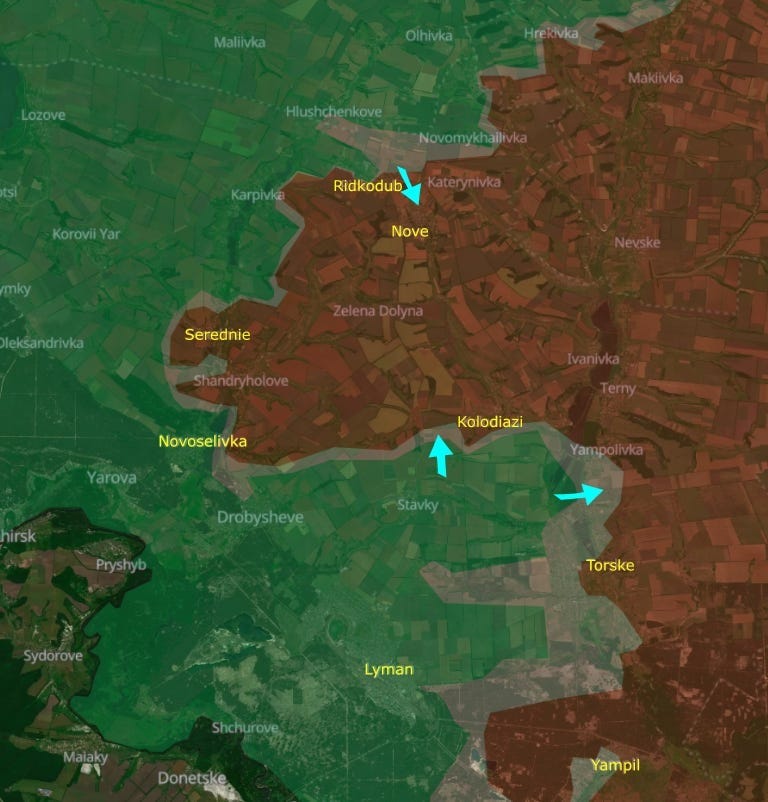
Two weeks ago there was a Russian video showing a Ukrainian attack near Nove because of the loss of vehicles and men. At the same time, there were reports of Ukrainian advances towards Serednie, Novoselivka and Kolodiazi, but not video. Last week there was a report of Ukrainian activity north of Torske, and there are reports of Russian attacks at these locations, but no video.
This week, the 59th Brigade, with its new commander, released a video of Russians running from drones in the forests near Lyman. The 59th was recently west of Pokrovsk. This matches other reports that there are a lot of Ukrainian drones in this sector, but very few videos.
It is possible that there is a video blackout in place, as has happened during some operations, but this is speculation.
35 km from the front, Ukrainian drones patrol Rubizhne, Sievierodonetsk and the surrounding countryside.
Sloviansk
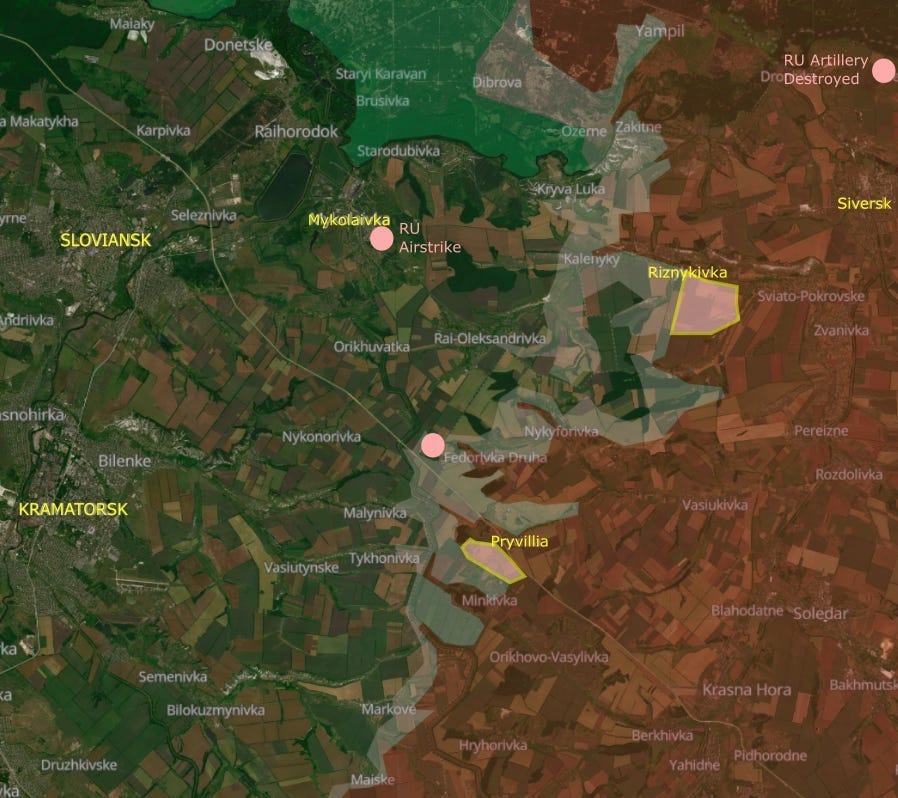
A Russian artillery piece is destroyed 12 km behind the lines. A bridge in Siversk is hit by an airstrike. Russia bombed Mykolaivka.
Footage from inside a cafe in Kramatorsk. No one was hurt in the video when a bomb landed nearby. Nearby could have been a hundred meters away. This is what you have to endure if you are Russia’s neighbor.
Kostiantynivka
Russian forces moving through Berestok and Illinivka reached northern Kostiantynivka. They may or may not have survived after being attacked, but the deeper penetration is a new milestone in the Russian advance.
An M113 with a cage withstood nine drone hits and pulled three wounded soldiers out of the city.
The Phoenix Border Guard drone team flew a quadcopter FPV 103 km to strike a truck with no relay assistance. 70-80 km strikes are normal. They had to fly that far to find a target.
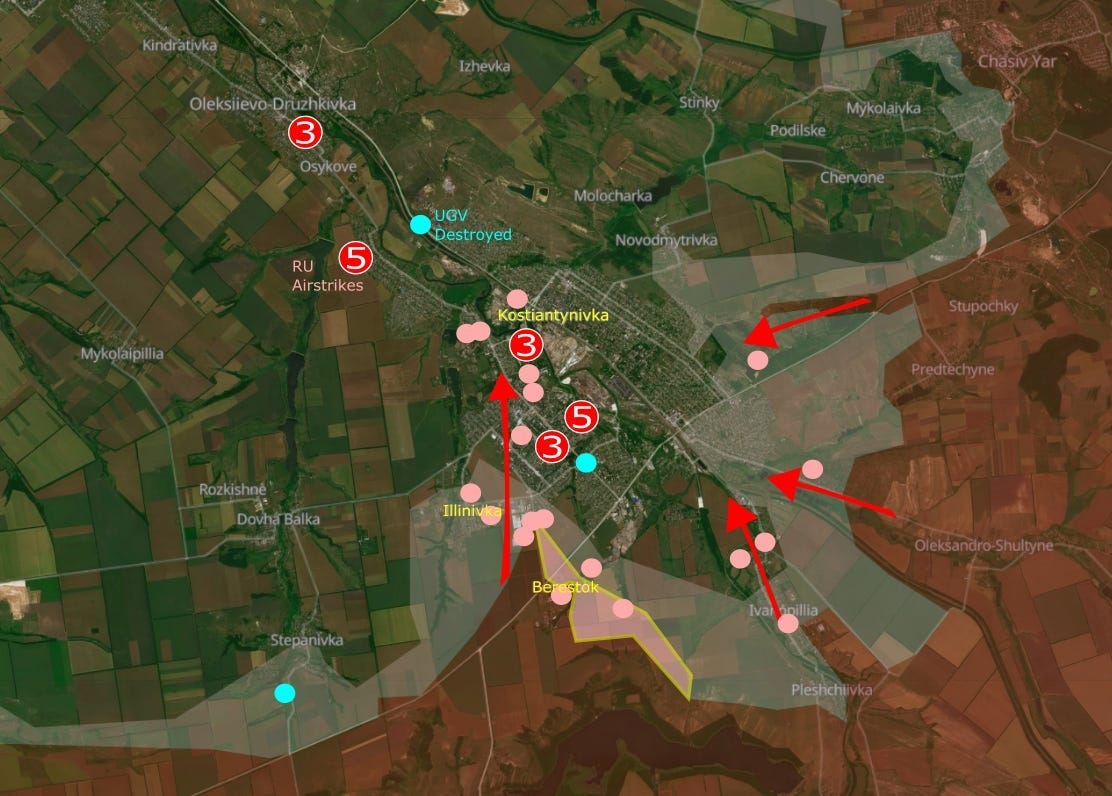
When Russia’s open invasion began in 2022, the city was only 22 km from the front lines Russia gained during its unacknowledged invasion of 2014-2021. That already placed it in artillery range. In the months that followed, shelling, drone attacks and airstrikes slowly increased as the Russians advanced. Three years ago they were only 10 km from the city. The pre-war population of 67,000 shrank to 2,000 last January.
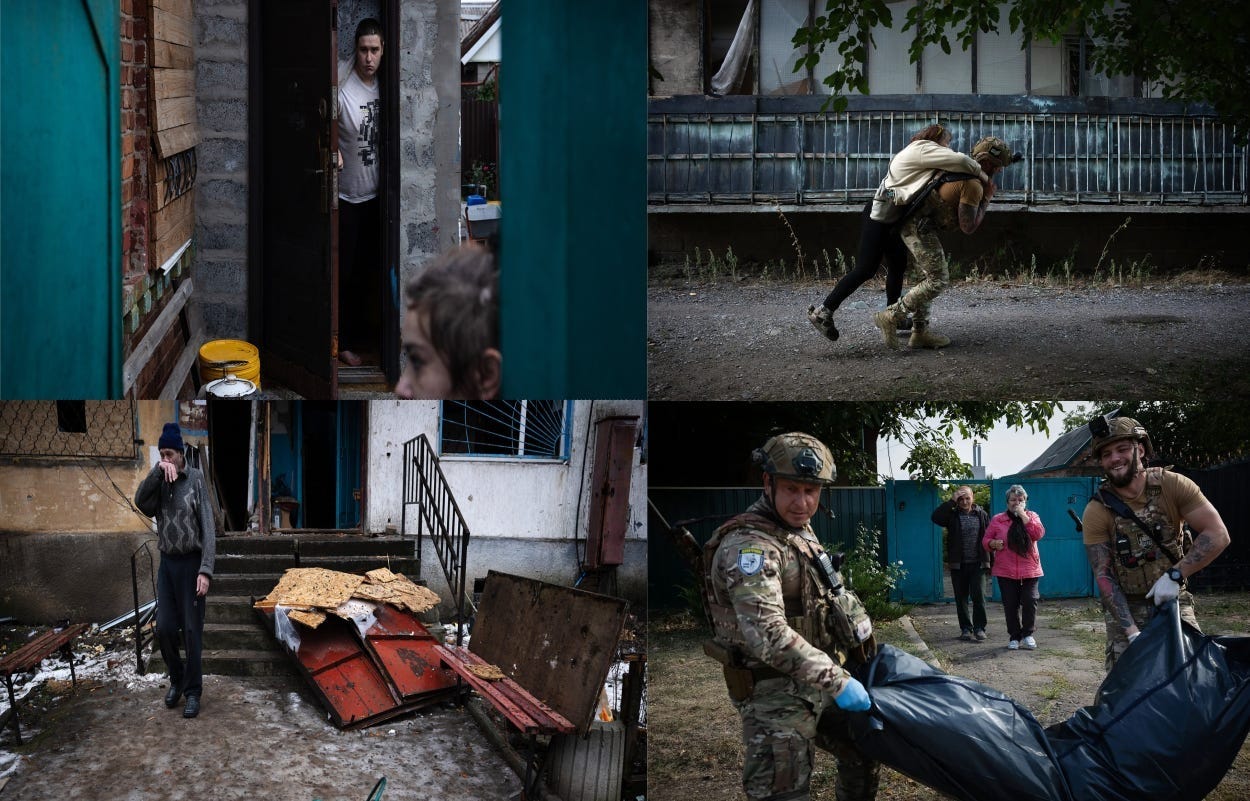
Some civilians refuse to leave. Others needed help to leave. Those that remain scrounge for firewood and food. Parents watched as police officers took away the body of their 44-year-old son.
About a thousand drones fly over Kostiantynivka every day now and the 28th Brigade shoots down 150 of them. Captain Alkhimov says it’s like a Middle Ages siege with modern technologies.
Military vehicles rarely drive into the city anymore because they are likely to be attacked by drones. Until recently, rescuers still made trips in their vans, risking their own lives to evacuate civilians who should have left long ago. On one trip, a Russian drone attacked a clearly marked van. No one was killed, but it stopped them from reaching an injured man that died. One driver was told that his van stinks, but he no longer smells death. Rescuers used to walk down the streets, or pound on the doors in apartments, calling out, “Evacuation!”, as if it was a medieval town struck by a plague.
During the last evacuation organized by the military, a family of seven with a two-year-old insisted on leaving together. They were attacked and a woman lost her leg. Like Kherson and other locations, the Russians deliberately hunt civilians even though it does not advance their military objectives. A small number of people still make their way out of the city on foot or riding on hand carts that others pulled. Evacuations by vehicle still happen at nearby Druzhkivka, which is 15 km from the front lines.
For those that remain, they scavenge scraps of wood and branches for fire, and venture out for food, knowing that they might be spotted and killed. Months ago, there were some, mostly old people, that still longed for the Soviet Union and were waiting for the Russians to come, but the drones don’t differentiate between civilians. It is unknown if those people survived or are still happily waiting for occupation. Those that are killed are buried near where they died because it is too dangerous to travel to the graveyards.
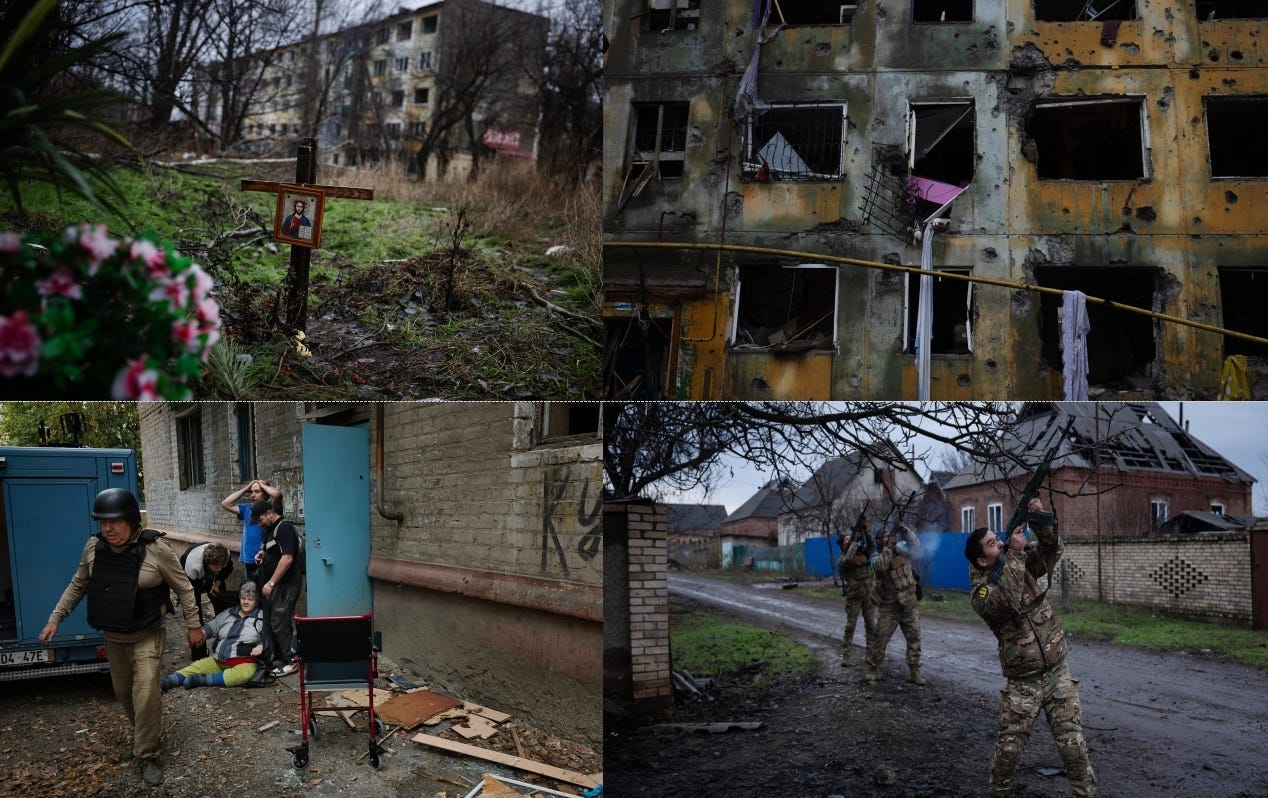
Most of Kostiantynivka is destroyed by the ever-present drones, bombs and shellings but some residents were still being evacuated even as the Russians were entering the city. Some residents will never leave the city.
Pokrovsk
The lines appear to be stable.
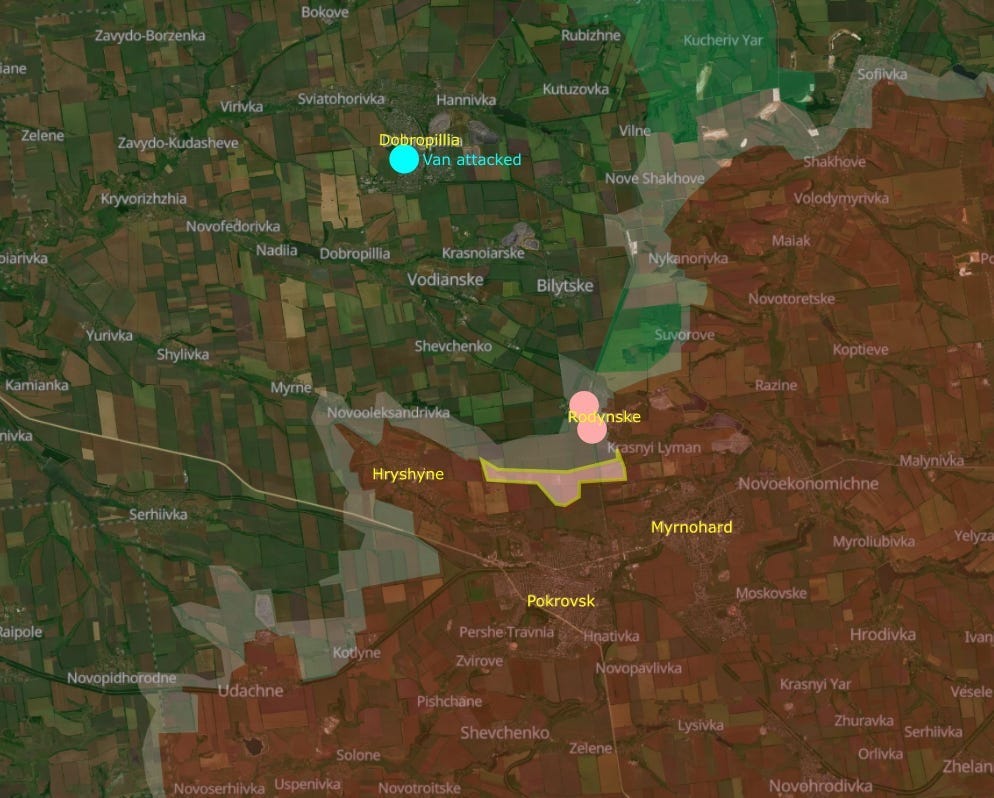
A Ukrainian van is hit by a drone in Dorbropillia. Ground drones, air drones and communication equipment are attacked by Russia’s Rubicon unit in Dobropillia.
Russians are attacked by drones near Rodynske. Russian Molniya drones are intercepted. A Russian in Hryshyne is hunted.
Zelenyi Hai
The limited reports turned out to be true. Ukraine advanced past Zelenyi Hai for five kilometers on an 11 km front, plus pushing forward around Vorone. DeepState is classifying most of the advance as a gray zone with only the Novoselivka area firmly under Ukrainian control. These advances are small unit infiltrations by Ukraine and have been underway since April but they have not been disclosed for operational security reasons. There are still very few videos released from this area.
Russian drones attack Ukrainian positions in Tolstoi.
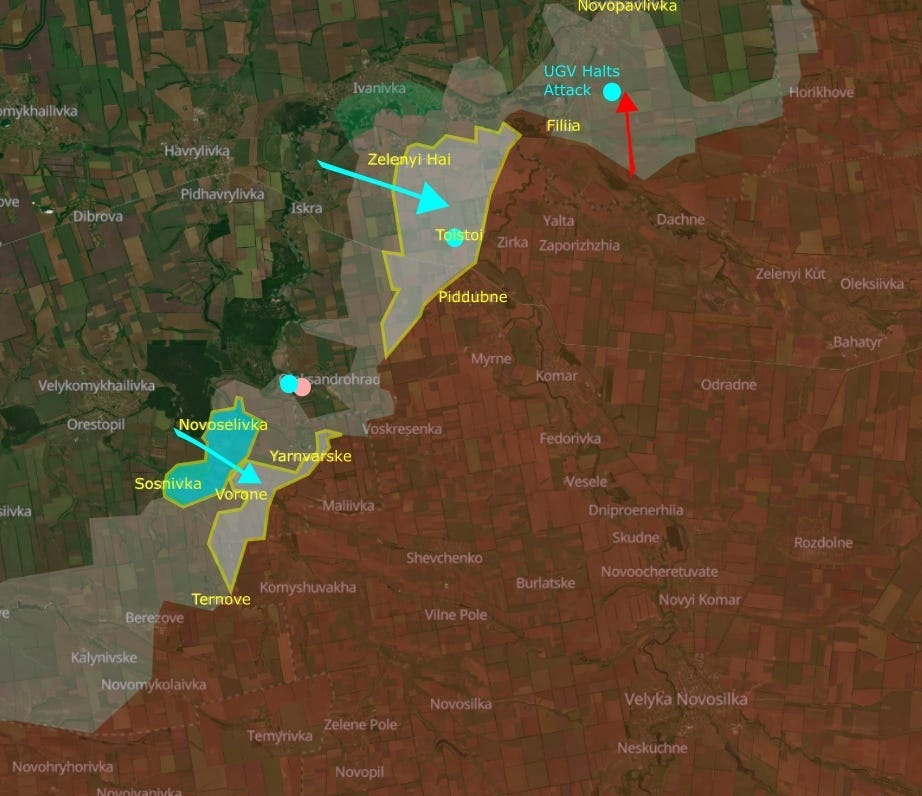
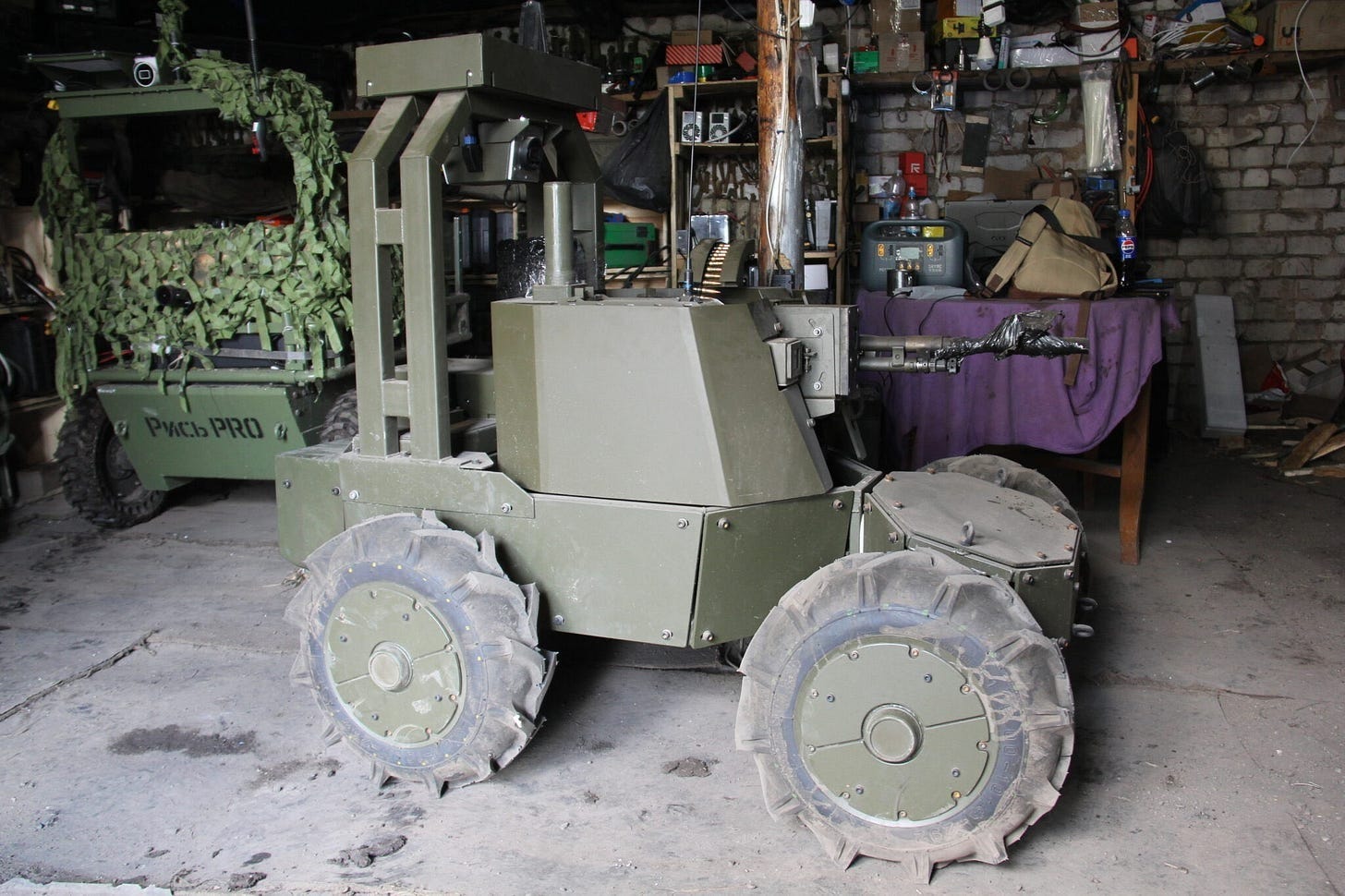
Russian infantry were moving in a treeline towards Novopavlivka in the fog when a ground drone named Lyut used its machine gun to suppress them. Artillery and drones finished them off. The 42nd Brigade uses ground drones for supplies, medical evacuations and combat missions. They can carry 200 kg and can perform up to 3 missions a day.
Huliaipole
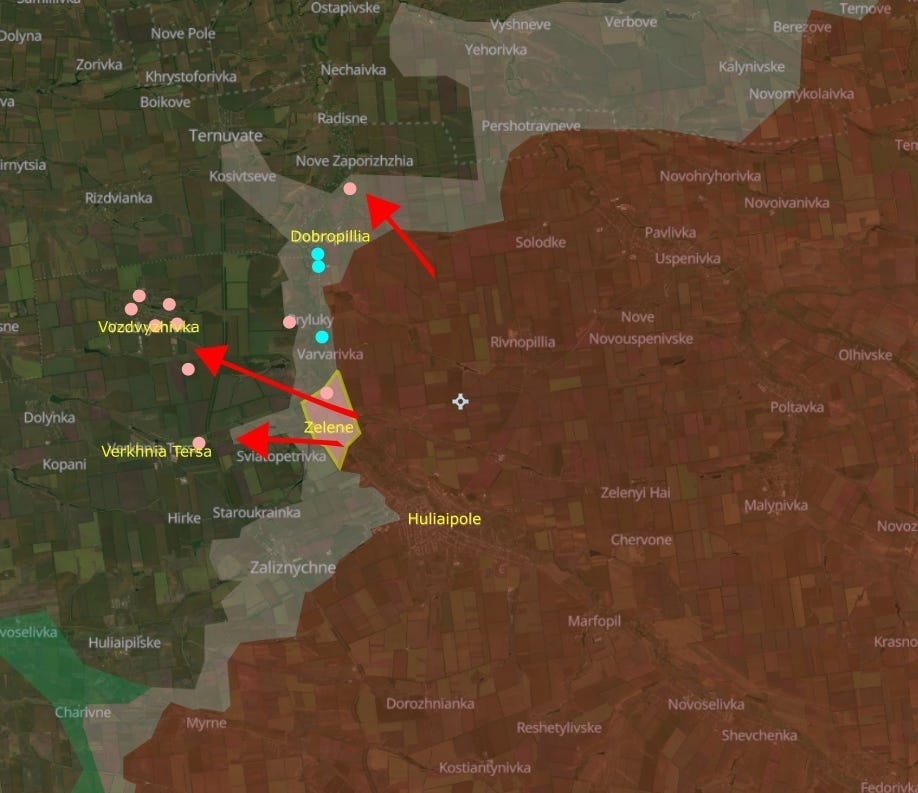
Russians are still infiltrating Ukraine’s defenses and being cleared. Vozdvyzhivka was entered by several Russians. Russians near Zelene, Verkhnia Tersa and Dobropillia are attacked.
Zaporizhzhia
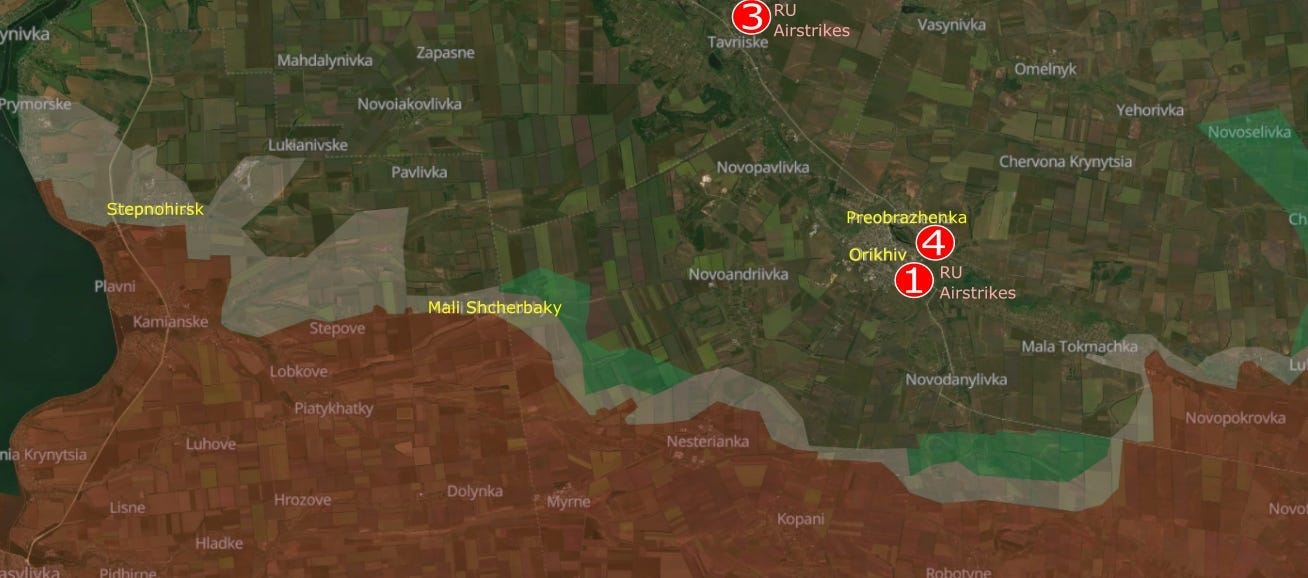
There are reports for a couple weeks now that Russians were pushed out of the ruins of Mali Shcherbaky. Russia bombed Orikhiv and Preobrazhenka.
Kherson
Ukrainian Barracuda naval drones of the 40th Marine Brigade launched FPV drones from their deck. One Barracuda had unguided rockets. Another had a retractable mast antenna to extend the range of the FPV drones. One FPV conducts reconnaissance and others attack.
Occupied Territories
Ukrainian drones are now dropping mines on roads. These mines have “a few dozen grams” of explosives and would not destroy vehicles but they could disable them, which could slow traffic and logistics, and create more targets. Civilian traffic has been theoretically banned from some roads, although it is unclear if that is enforced. The mine has a 10 minute delay to arm and is designed to self-destruct in 90 days, but those mechanisms don’t always work.
A truck drives at night while mobile teams fire machine guns at a drone in the distance. Headlights attract drones at night, but headlights are needed to see possible mines on the road.
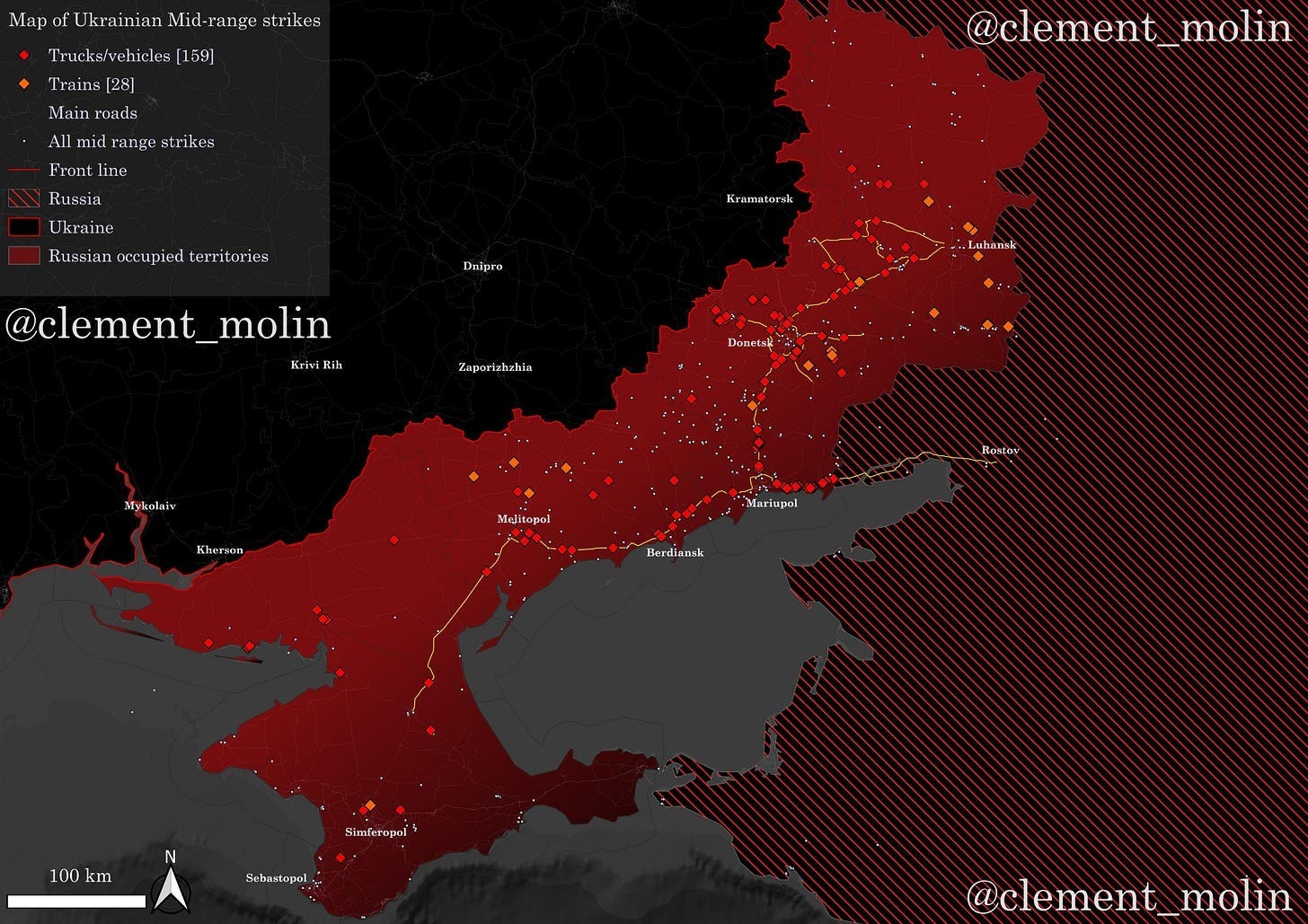
The mid-range strikes of targets over 50 km began at the end of last year and intensified in the last two months. In 2026 Ukraine attacked over 1000 targets that have been geolocated, including 150 vehicles, 30 trains and 400 warehouses. More attacks happened that were not geolocated.
Trucks east of Mariupol are attacked by Azov and many attacks are observed by another Ukrainian drone. The 412th brigade’s contribution to vehicle destruction between Mariupol and Melitopol. A truck has to drive off the road to get around four wrecks at one location. More vehicles. Russian trucks aren’t safe at night. Attacks on three trucks at one location blocked the road. Two drones attack one truck. At the 7 second mark, a white air defense truck with a machine gun is attacked. A truck towing a truck was hit.
KAMAZ builds about 40,000 trucks a year.
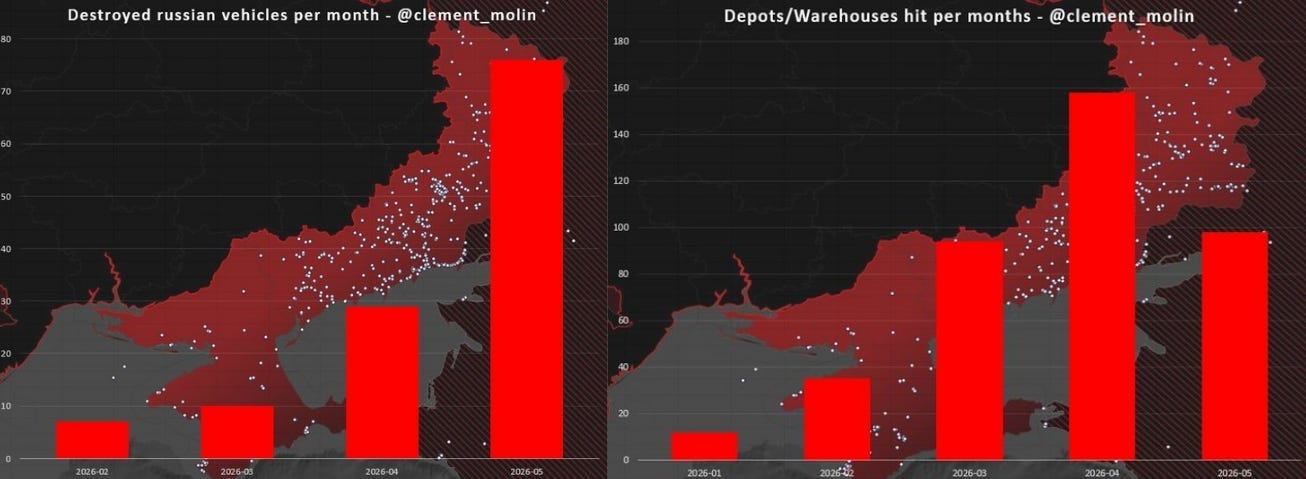
(Left) Attacks on vehicles (right) and depots and warehouses have increased dramatically over the last two months.
The 3rd Corps showed their attacks on Russian targets in Luhansk up to 205 km away.
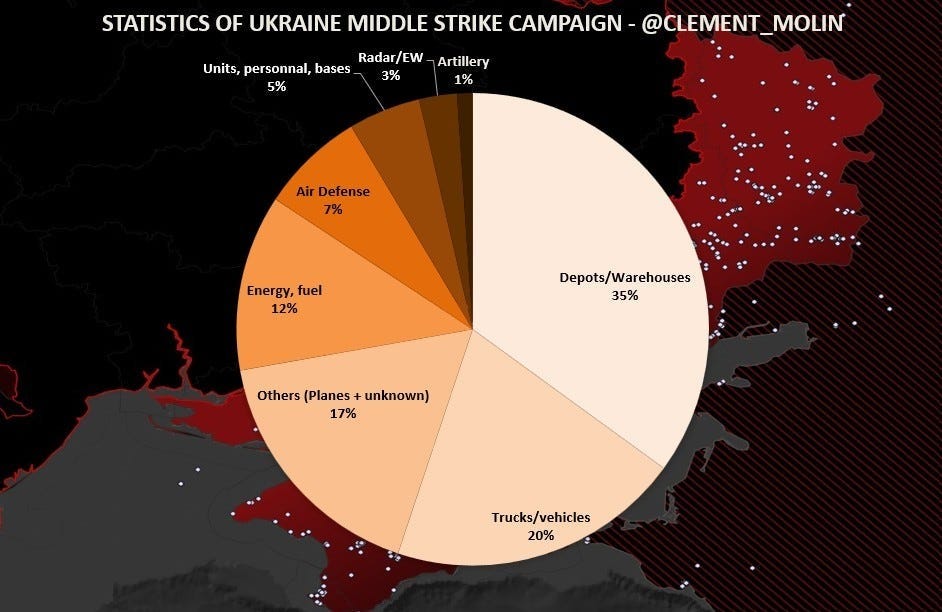
35% of the over 1000 attacks hit warehouses and depots. 10% hit air defense systems, radars and EW equipment. That’s at least 100 components of air defense systems.
Because Russia’s mobile air defense teams need Telegram, and because the Ukrainian mid-strike drones are a high-level threat, Russia is granting the mobile teams access to Telegram again in the occupied territories.
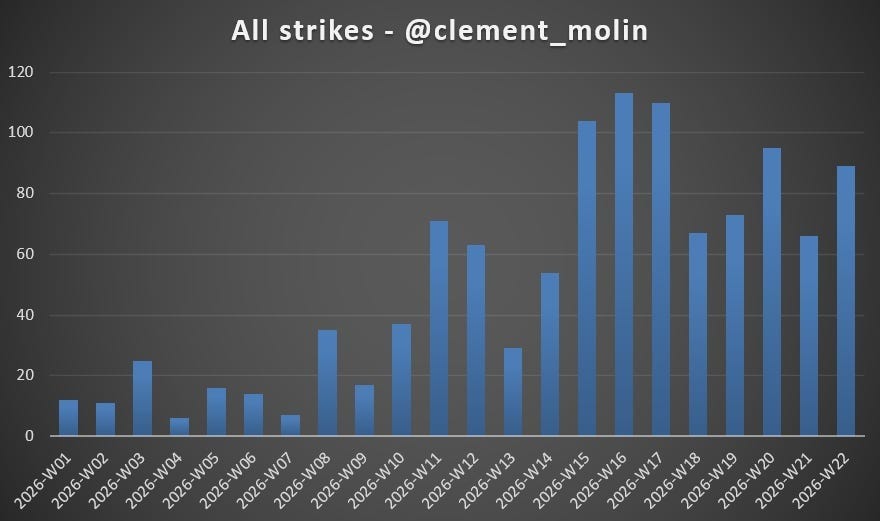
The number of attacks by week in 2026.
Storm Shadow/SCALP missiles destroyed a Russian command center in Luhansk. The details of the mission were not disclosed. An aircraft maintenance and repair facility was attacked with Storm Shadows in Taganrog on the border with Ukraine. Storm Shadow missiles destroyed Russia’s naval air forces headquarters in Sevastopol. Black bags were being loaded on trucks and ambulances were still making runs at the headquarters hours after the attack. As is more common in recent Ukrainian attacks, enough munitions were used to destroy the targeted building.

When faced with an aerial threat, it is important to blend in with the road to escape detection. The actual intent was to trick any AI that was being used.
Five radars, two Pantsir air defense systems, 13 trucks, a rail fuel car, a command post, and a mobile fire team was just one day’s work for Ukraine’s Unmanned Systems Forces. Other drone organizations attacked more targets. Some of the last five oil storage tankers in Feodosia were attacked. With multiple heat signatures indicated, hopefully all five were destroyed.
An S-300 launcher, a radar, railway tankers, a reconnaissance drone, two warehouses, communication equipment and trucks were hit.
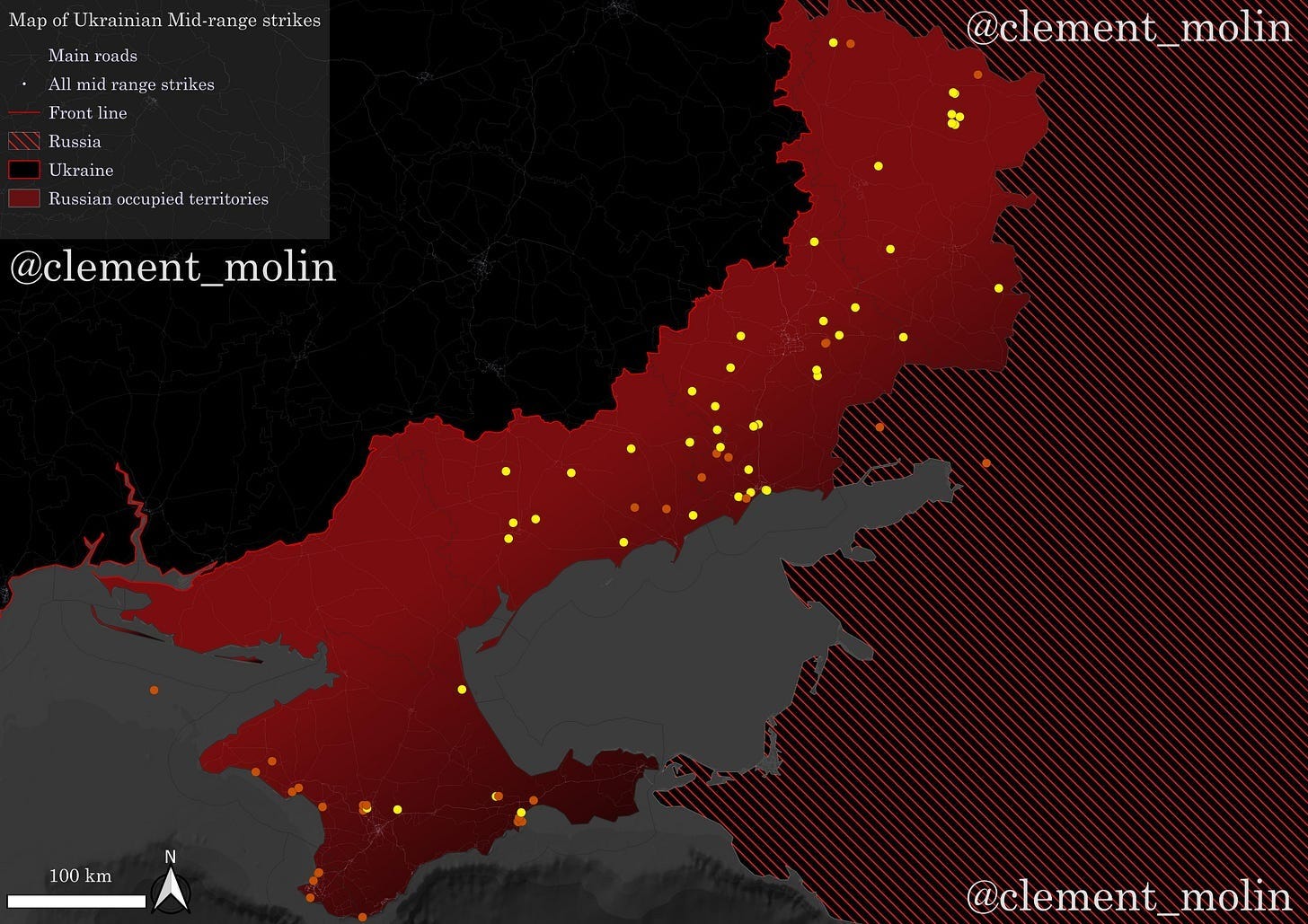
The attacks on Russia’s air defense systems make other mid- and long-range drone strikes possible.
Last July, Britain and France restarted production of the missile to restore stockpiles and aid Ukraine. The missile has a 450 kg warhead and has a range of 250 km for its export version and 560 km for the British and French armies. The goal was to produce 50 missiles a month.
Storm Shadows hit a Russian command and communications post in Luhansk. There will be more of these over the months.

Father Stepan Podolchak in the occupied Kherson region refused to transfer his Orthodox Church of Ukraine to the Moscow Patriarch. They abducted him, barefoot and with a bag over his head and ransacked his house. Then they tortured him. Two days later, he was dead.
Russia
A lot of Russia’s oil infrastructure was attacked in May:
May 29 - Lukoil-Volgograd Refinery (Volgograd Region)
May 27 - Tuapse Refinery 5.0 (Krasnodar Krai)
May 25, 22, 8 - Yaroslavl Refinery (Yaroslavl Region)
May 23 - Grushovaya Hub (Krasnodar Krai)
May 22 - Shesharis Oil Terminal (Krasnodar Krai)
May 21 - Syzran Refinery (Samara Region)
May 19 - LVDS Yaroslavl (Yaroslavl Region)
May 18, 20 - Lukoil-KSTVO Refinery (Nizhegorod Region)
May 17 - Moscow Refinery (Moscow Region)
May 15 - Ryazan Refinery (Ryazan Region)
May 13 - Tamanneftegaz Oil Terminal (Krasnodar Krai)
May 7 - Lukoil-Permnefteorgsintez (Perm Krai)
May 5 - Kirishi Refinery (Leningrad Region)
May 4 - Kuibyshev Refinery (Samara Region)
May 3 - Primorsk Oil Terminal (Leningrad Region)
May 1 - Tuapse Refinery 4.0 (Krasnodar Krai)
The Tuapse refinery was hit for the fifth time in six weeks. Four refinery units and secondary oil refining units were damaged at the Volgograd refinery. The Saratov refinery sprouted several fires. A pair of drones fly towards Saratov.
An oil depot in Bashkortostan caught fire and destroyed more than one tank but the cause of the fire is unknown. An oil depot at Matveev Kurgan, 15 km from the Ukrainian border, and one in Unecha was hit.
One more storage tank at the Yaroslavl-3 pumping station was hit.
An aircraft maintenance and repair facility was attacked in Taganrog. Two Tu-142’s and an Iskander-M ballistic missile launcher were destroyed. The Tu-142’s had been stored there for years. A fuel tank, an oil tanker and an administrative building in Taganrog were also attacked.
Storm Shadow missiles also hit a radio support battalion in Taganrog.
Black Spark sabotaged a railway tank car in Krasnodar.
Russia needs money but they stopped exporting gasoline at the end of March. Because of the damage to refineries, they are considering banning the export of diesel and kerosene. Currently, Russian production of gasoline has been reduced by 30% and the production of diesel is 25% below capacity.
Russia is purchasing 17,000 tons of gasoline from Belarus, which is 58 times more than they did at this time last year. Still, Russia consumes 100,000 tons of gasoline a day, so that is only 17% of one day’s consumption.
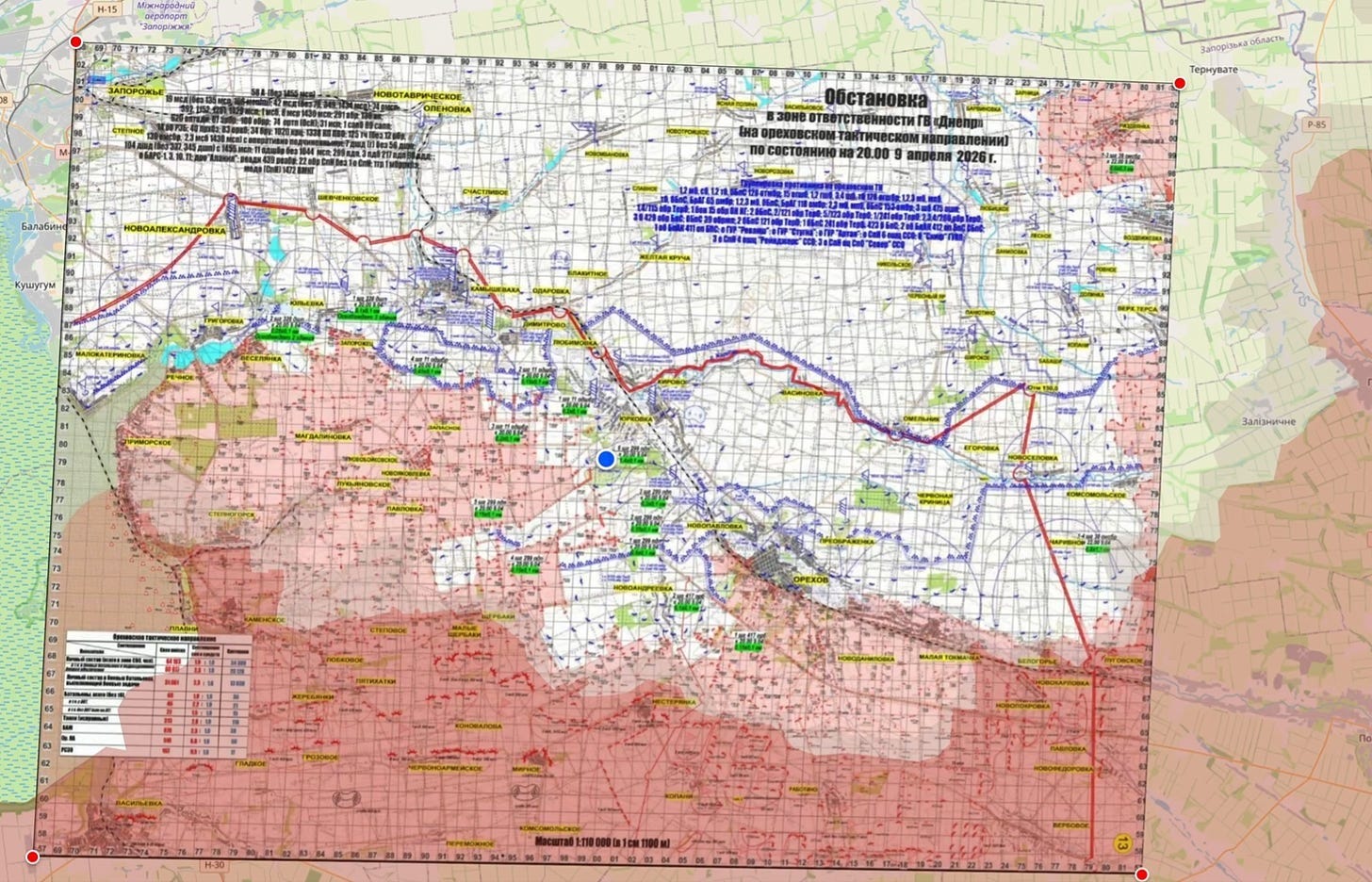
Russian military personnel are constantly overstating their accomplishments to their chain of command. Last December they claimed they took Kupiansk when infiltration teams were in the city’s center. The map shown above supposedly shows the territory they claimed to occupy. In fact, they only controlled the darker color. They had a low density of infiltration teams in the gray area that Ukraine recently cleared, but control of the pink area was a fantasy.
Footage from the defense of the Admiral Essan frigate on May 23rd.
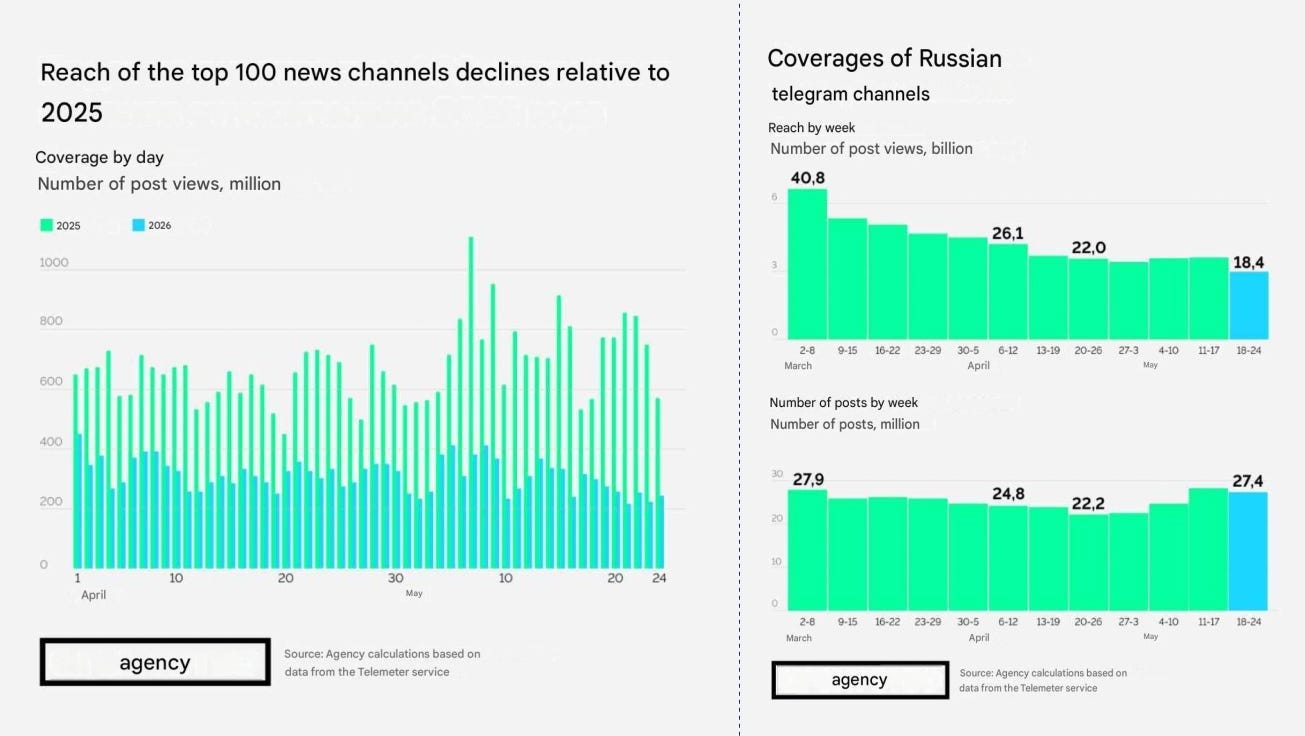
The posts made on Telegram remain the same but since it was banned in Russia, the number of people that read the posts dropped by 47%. The people that consider Telegram their primary source of information dropped by 25% to 18%. The Russian government wanted users to move to Max, and now 10% of Russians consider it their primary source of news.
Ukraine
A Kh-101 was intercepted by an air defense missile over Kyiv.
Another view of the Oreshnik missile at Bila Tserkva two weeks ago. A view from inside an apartment. A second missile was used north of Donetsk. You can count the six warheads. They appear as lines because each warhead has six submunitions. Without explosives, they’re similar to 36 scattered, unaimed shotgun pellets. This crater left by one of the submunitions in Bila Tserkva is about the size of a 155 mm shell. The estimated cost of each missile ranges from $40-100 million, so that crater cost $1.1-2.7 million to make. Back in January, they had 3-4 of these missiles. Russia hopes to build six of these missiles in 2026. A Flamingo attack on Votkinsk last February might impact production since Iskander and Oreshnik components were built there.
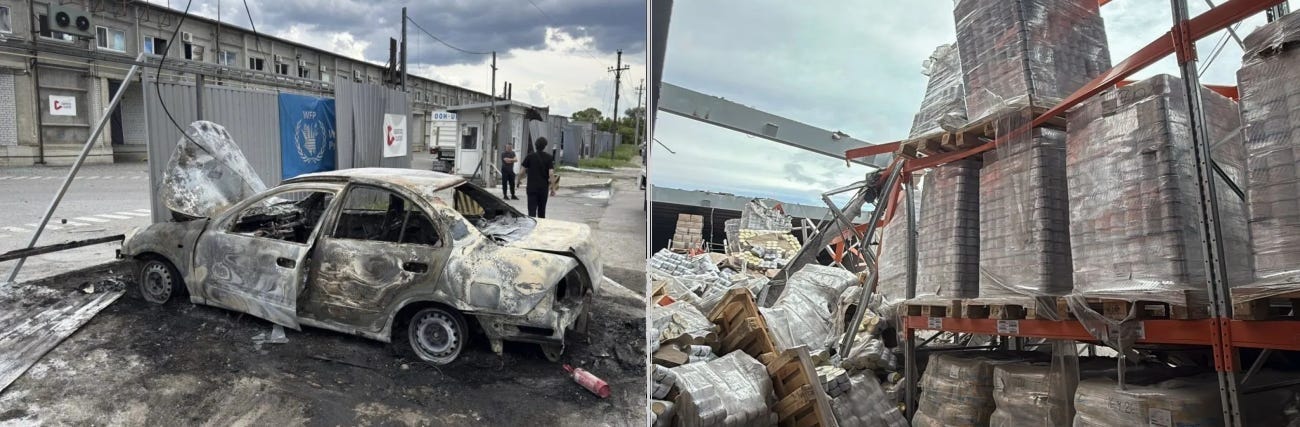
A Russian ballistic missile hit a UN warehouse in Dnipro that had food for 130,000 people. A drone hit the warehouse in November 2025. The UN could not figure out who launched the missile so they did not name Russia. To be fair, it was just a guess on my part that the Iskander came from Russia. In the past 18 months there have been 84 incidents when some unknown entity hit UN warehouses, distribution points, transport vehicles and partner facilities in Ukraine. Whoever is doing that needs to stop.
A shopping mall in Odesa was hit.
A snapshot of one 24 hour period in Ukraine counted 764 strikes in 44 settlements. That included 22 airstrikes, 521 drone attacks and 219 shellings by artillery. Because of days like these, the Russians kill 70-100 Ukrainian civilians each week. Building codes have been changed to require shelters for residences and infrastructure facilities.
A priest of the Ukrainian Orthodox Church (Moscow Patriarchate) walked around Odesa in his cassock and marked the geolocations of potential targets on Google Maps. In March 2024, an Iskander missile landed on the coordinates he provided based on a suspicion that military personnel might be located there. Emergency services arrived and a second missile landed at the same location. He also provided the location and level of protection for an electrical substation and then gave a damage assessment after it was hit. The location of air defense assets was also sent to Russia.
815 Ukrainian civilians were killed and 4,174 were wounded in the first four months of 2026, a rate that is 21% higher than in 2025. Tens of millions went without heating or electricity during the winter. These attacks cost billions of dollars and they do not advance Russia’s war effort. Russia is diverting efforts to win the war in order to cause misery.
A Dutch and a US group estimate there are between 5-600,000 Ukrainian military casualties of which 140,000 might be killed as of the end of 2025.
The commander of Ukraine’s 3rd Corps, Andriy Biletsky, says that the Russian army is incapable of making a major breakthrough and that the next six months to nine months will be a critical point for Ukraine to seize the initiative and advance with careful attacks, which would strengthen Ukraine’s position in peace talks. He says Russia has the advantage with fiber optic drones and lost communications capability when Starlink was denied to their military. Ukraine has the advantage with ground drones and heavy bomber drones. The 3rd Corps expects to replace 30% of its infantrymen with ground drones by 2027.
Diplomacy

A month ago, an independent Senator said the Iran war provided Russia with $40-80 billion from oil. He also displayed a chart showing that the US has now abandoned Ukraine. Hegseth said in this video that the chart was a beautiful thing and is exactly what the American people want. After Zelensky sent a letter asking for Patriot missiles, Hegseth says the US will find a way to help Ukraine to help Ukraine defend itself
A Russian drone hit an apartment building in Romania. Two were injured. Once again, NATO promises to defend every inch of allied territory, next time. Several Russian drones have landed in Romania before but this is the first time there has been serious damage and injuries. Russian drones have crossed into Poland before, as well. Despite years of Ukrainian experience with much higher numbers of drones, most NATO states are far behind Ukrainian capabilities.
Some NATO nations are closer to achieving Ukraine’s current capabilities.
There have been 24 drone incidents in the Baltic countries since 2025 due to Russian jamming and spoofing of Ukrainian drones flying by. Latvia has the most realistic drone testing range in NATO and can provide a rough approximation of battle conditions in Ukraine. Learning from Ukraine, Latvia already has optical and audio sensors on the border to detect drones and they will place tactical radars 10-20 km apart. Next month, they will place four-person mobile drone interception teams on the border, but this is just an interim solution. Since Latvia is short of manpower and it would take a lot of teams to cover the border, Latvia will eventually deploy fully automatic interceptor drones in canisters that can be remotely launched by a command center. In several weeks, they’ll start testing automated .50 caliber turrets. They are also developing electronic warfare and inexpensive missile systems.
There has been a lot of military activity in Belarus. If Belarus attacked Ukraine it would consume Ukrainian resources but they would be able to stop the invasion. Robert Brovdi told Belarus that 500 targets have already been chosen in case of an attack. Ukrainian drones would weaken the Belarus security structure and weaken the regime’s hold on the population.
Putin convinced Sweden and Finland to join NATO. Alarmed about Greenland, Trump may have convinced Iceland to join the EU. It didn’t help that the US ambassador to Iceland joked that it could become the 52nd US state. They are hesitant, though, having seen Ireland’s quota for fishing being reduced because that is responsible for 10% of Iceland’s GDP. But the euro is more stable than the krona, and inflation in the EU is half that of Iceland, and the EU might be flexible on fishing quotas.
Russia is warning embassy staff to leave Kyiv. The EU ambassador to Ukraine said Western diplomats won’t leave. Poland said that if its embassy is hit it will be regarded as deliberate and intentional. None of the embassies have left. In fact, the government-in-exile of Belarus opened up a new embassy in Kyiv. They will coordinate action between Ukraine and Belarusian democratic forces and support Belarusians living in Ukraine.
Lithuania has a 15,000 soldier army. Germany is forming a 4,800-man brigade there by 2027 and Germans in uniform are being thanked, receive discounts when buying coffee and are greeted with smiles. In Germany, many don’t like traveling to work in uniform because of the reception they receive. When Lithuania joined NATO in 2004, President Bush told them that any of their enemies would be the enemy of the US. A Lithuanian said, “At this moment, the United States does not feel like a guarantee.”
Excuses are never needed to exercise power but are often deployed to minimize criticism when power is used. About 5,000 Cubans fought for Russia in Ukraine and Russia paid the Cuban government $25,000 for each soldier. These soldiers informed their government about the effectiveness of drones. Cuba recently acquired 300 military drones and is seeking more. Russia and China have signals intelligence stations in Cuba. The US indicted Raul Castro, the brother of Fidel, for ordering the shootdown of two civilian planes in 1994. The indictment of Venezuela’s leader Maduro was a stated reason for the military operation there. Senator Lindsey Graham, whose support for Ukraine is only surpassed by his obsequious support for Trump, said, “I believe the liberation of the wonderful people of Cuba from the clutches of communism is close at hand.”
Dell computers head pledged $6.25 billion for a Trump accounts program in December. Trump bought over $1 million in Dell stock in February and spent a lot of time praising Dell nine days later. The Pentagon just awarded a contract to Dell for $9.69 billion.
Donald Trump Jr. invested $65 million in Vulcan Elements, a small startup that makes rare earth magnets. Three months later, the White House made calls to the Pentagon to rush a loan to the company. When the Pentagon announced the $620 million loan in exchange for a $50 million stake in the company, the company’s stock value increased from $200 million to $2 billion.
Equipment
Ukraine’s new Behemoth is a Shahed-style drone with a 300 km range. It has a 40 kg high-explosive fragmentation warhead in the nose and a 35 kg thermobaric warhead behind it. It can be flown in autonomous, semi-automatic and full pilot control mode. It’s already being used in combat and is in serial production.
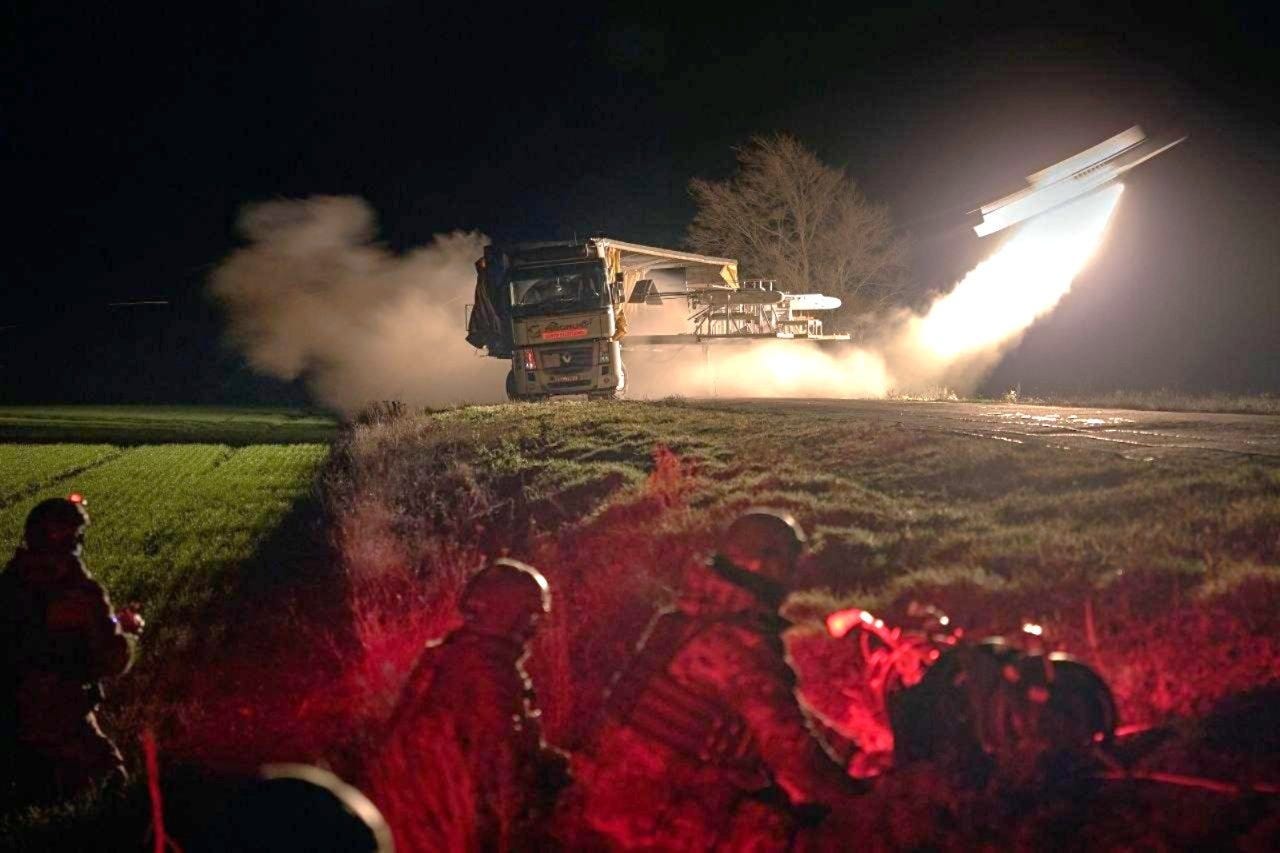
Video of a night launch of an FP-2 drone from a truck with rocket assist.
Sweden will donate up to 16 Gripen aircraft in 2027 and Ukraine will buy 100-150 aircraft over several years. Ukraine plans to produce Gripen aircraft in Ukraine in 2033.
The Chinese company Harxon is supplying Russia with 7-, 8-, and 16-channel CRPA satellite navigation antennas which protect against Ukrainian electronic warfare systems. The company tries to disguise the sales but an invoice for 200 antennas for $800,000 was discovered. The company also supplies a 32-channel antenna, which is effective against many EW systems but Ukraine says the Lima Quant system can defeat it.
Lima and the Kometa Antenna
Cascade is an electronic warfare company that has offices in the US and Ukraine. Some of the developers are members of Ukraine’s electronic warfare units. They started developing a system in 2022 to fight Russian cruise missiles. Ukraine’s military was skeptical at first, but after the company invested $2 million of their own money to develop the system, and it proved its effectiveness on the battlefield, the government was finally convinced. Ukraine started using the Lima systems to protect the military in July 2024, and in October 2025 they began protecting civilian infrastructure.
Lima worked by jamming the GPS signals of missiles and bombs. Without a GPS signal making corrections, the weapon can deviate from its course by two kilometers every 100 km it travels. If the target is in the city, though, any deviation from that target can still destroy other nearby structures.
This is why Lima also spoofed incoming weapons by overriding the GPS signal and substituting its own coordinates. In an early use of the EW system, an incoming weapon thought it was in Peru, whose capital is Lima. Using false coordinates, Lima can convince the weapon system to attack empty fields.
The effectiveness of glide bombs (KABs) was also reduced. Even if the jamming of the glide bombs didn’t start until 10 km before impact, that would still create a deviation zone of 200 meters. If the bomb detonates 20 meters from a bunker, the bunker will survive.
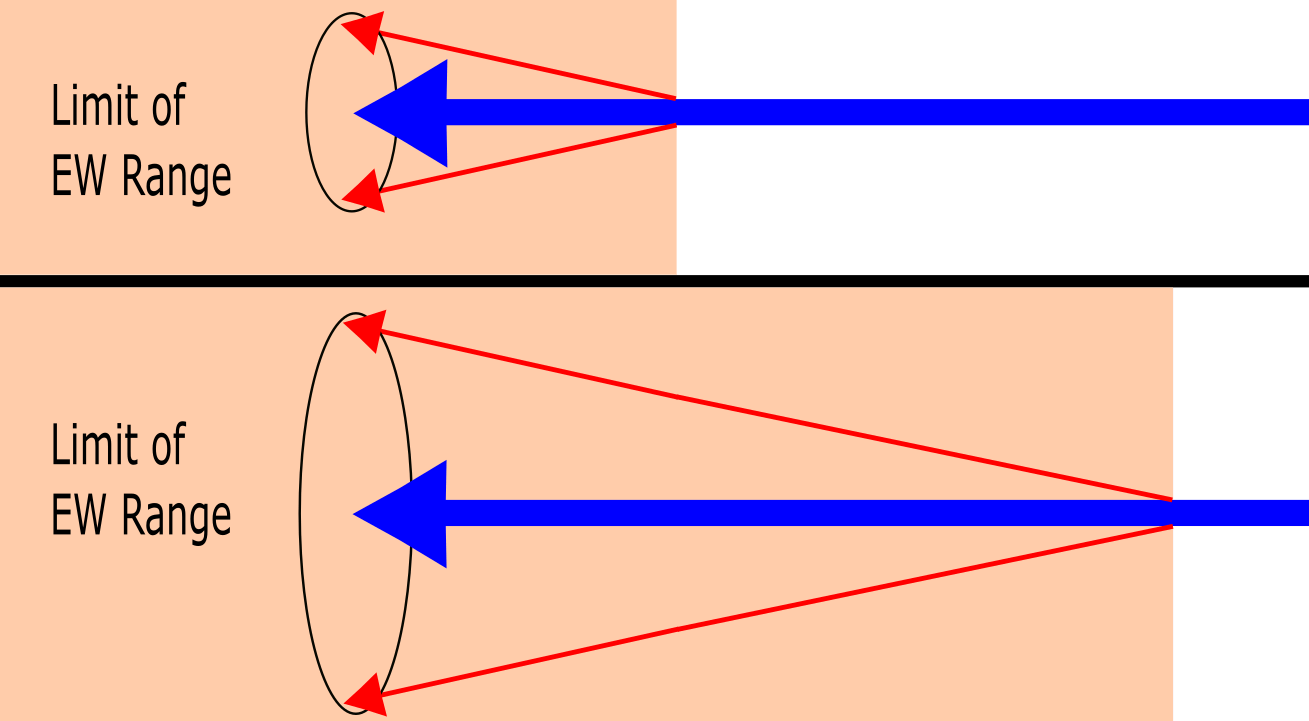
Based on internal navigation alone, an aerial weapon can deviate up to 2 km for every 100 km it flies. If a weapon is unjammed and its location is constantly updated by GPS or GLONASS, it will fly along its intended path (represented by the blue arrows). If it does not receive updates from a navigation satellite it will start to deviate (represented by the red arrows). The sooner it starts to deviate, the wider the possible impact zone will be. This is different from spoofing, which tells the weapon system exactly where to land, perhaps on an empty field.
This is electronic warfare, though, and for every counter, there is a counter to the counter. Russia developed the Kometa-4 system that used four radio receiver elements. Because of Lima, they upgraded it to eight receivers in April 2024, providing it with more data to determine if a signal is legitimate or fake by using the strength and angle of the incoming signal. If the fake signal is too weak then the true navigation signal will provide the legitimate data. If the fake signal is too strong, it will be filtered out. If a signal is coming from the ground, then it cannot be a navigation satellite signal and is filtered out.
A phased array antenna, like the Kometa, can filter out one less jamming signal than the number of elements it has. The Kometa-4 phased array antenna had four elements, which meant it could filter out three jamming signals at a time. Ukraine had to use four Limas to brute force jam it, so Russia upgraded to the Kometa-8 system, which would require 8 EW systems to jam it. Ukraine captured an intact eight-receiver Kometa system and figured out how to defeat it, so Russia upgraded it to 12 receivers by March 2025. By June 2025, Russia was using the Kometa-16 on selected weapons.
The Kometa-12’s and -16’s weren’t just additional elements added to the antenna, though, they were part of a redesigned system that required much more than 12 and 16 jammers to overcome them. With this new system, it would take 19 jammers to defeat a Kometa-8 system and the higher level systems would withstand 100 jammers. On top of that, when a KAB was jammed, it could resist until it was only a few hundred meters from their targets, leaving little time for a wide deviation.
In 2024, Russia dropped between 3,200 and 3,500 bombs a month. In 2025 that rose and Russia dropped 1,370 bombs during one week in October. The missiles and drones attacking Kyiv’s cities at least had a chance to be intercepted, but the bombs were a serious threat to Ukraine’s military.
When the new Kometa system appeared in March 2025, Cascade worked with Night Watch, a Territorial Defense electronic warfare unit, to upgrade the Lima. Three months later, they developed the Lima Quant. It used higher frequency signals and was able to prevent the Russian antenna from determining the direction its signal came from, ground or sky, which removed one layer of defense. It is also able to conduct a cyberattack on Russian navigation systems. When the antenna downloads the data from the satellite, Lima Quant makes it pull the incorrect data and can’t update with the correct data until long after it is no longer being suppressed by Lima.
The effect on the Russian KABs was immediate. The bombs had zero accuracy and could only rely on random chance to hit a target. To counter the jamming, Russia started dropping 8, 12 and 16 bombs on the same target in the hopes that one of them would hit the target.
A Ukrainian defense industry spokesman said, “The KABs either did not hit or they could not even be released, because the guidance system produced a navigation error. Russian pilots did not understand what was happening, because navigation on these CRPAs (antennas) was lost 100 km before the line of combat.”
The spokesman continued, “The effectiveness of KABs dropped to zero. On a roughly 700 km stretch of the front, the enemy dropped 869 KABs in one of the previous months. The consequences of these strikes were minor injuries to eight servicemen.”
It wasn’t just bombs that were affected. Cascade says that their system defeated 20,500 Shahed drones and dozens of ballistic and cruise missiles in the last 18 months. The high speed of the Kinzhal missiles were difficult to intercept for non-Patriot systems, and Patriot missiles were in short supply. Yet since last summer, 32 Lima devices were able to jam 58 out of 59 Kinzhal missiles that were launched. Any noise in sufficient volume would be able to jam a receiver, but Ukraine decided to use the song, “Our Father is Bandera, Ukraine is our Mother”. The accuracy of Iskander missiles has also decreased because of Lima.
The Kometa and other CRPA’s can be suppressed at 50 km, KABs can be suppressed at more than 100 km, and cruise and ballistic missiles can be defeated at ranges of 300 km.
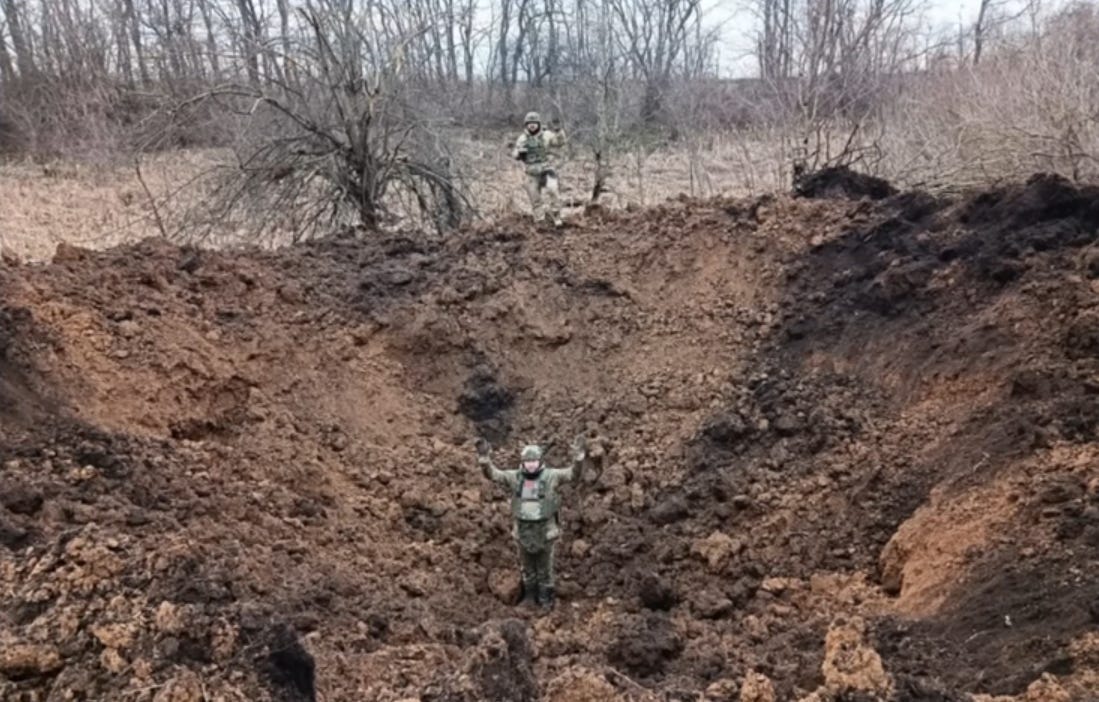
The crater from a Kinzhal missile that was directed to a harmless location.
The Kometa antennas were still a threat to areas not covered by Lima Quant. They are made at the VNIIR-Progress workshop in Cheboksary so Ukraine attacked that facility with drones in June 2025, July 2025, November 2025 and February 2026. In May 2026 the facility was attacked with two drones and a Flamingo missile. It is not known how much these attacks slowed production or research but they did not eliminate production.
Cascade provided more than 400 Limas to Ukraine at a cost of $67,000 each. It takes 30 to 100 units to protect a major city, which would cost $2-6.8 million. A single Patriot PAC-3 MSE missile currently costs $5.3 million (The US just started a program to develop a missile that will cost under $1 million). In order to protect all of Ukraine from drones and cruise missiles it would cost $1 billion (14,782 Lima systems). In order to protect all of Ukraine from ballistic missiles it would cost an additional $800 million (11,826 more Lima systems). With only 400 systems, they can’t cover the entire country, and there was recent evidence that Lima systems weren’t active on the front lines in the Huliaipole region.
This is the realm of electronic warfare. It is likely that Russia is already working on ways to defeat Lima Quant. It is also likely that Ukraine is already thinking of ways to improve the system. Ukraine constantly changes Lima based on the characteristics of Russian weapons, and they often change where it is placed and how it is used. It is only a question of time before things change again.
Starlink Communications
Traditional communication satellites are in geostationary orbits 35,786 km above the earth and rotate with the earth in the same relative position. Because of the distance, it takes half a second or more for the signal to travel from earth to the satellite and back.
Starlink has 9,000 satellites between 340 and 550 km above the earth. They are not stationary relative to the earth and take 90 minutes to complete an orbit at 27,000 kph. Communication with one satellite only lasts a few minutes before it’s handed off to the next satellite.
A Starlink terminal tracks the satellite without moving parts because its phased array antenna can manipulate the direction of the signal electronically by delaying sending the signal to its 1,152-1,280 elements by fractions of a nanosecond. This creates an interference pattern of waves and troughs. The primary wave lines up in one direction and creates the signal. The troughs line up in all other directions and cancel the signal. Small waves with low power also form and are called side lobes. By focusing its sending and receiving signals on the satellites, it is difficult to receive signals from other directions, including jamming signals. Jamming signals would have to be loud enough, through power or proximity, to overcome the spatial filtering of a directional antenna.

(Left) If the crest of one wave meets the crest of another wave of the same frequency at the same point, the waves are added together to create more powerful waves. (Center) If the crest of one wave meets the trough of another wave then they cancel each other out. (Right) Two sources of energy send out waves. Where the crests meet, the height of the wave is twice as high. Where the trough and the crest meet there is a null.
There are three ways to deny Starlink communications. The first is to jam the GPS signal for the terminal. The terminal must know exactly where it is, even while moving, so it can aim its antenna to a Starlink satellite. If it cannot receive a GPS signal, or if the GPS signal is spoofed with a false signal to provide a false location, it will point its antenna in the wrong direction and be unable to communicate with the satellite.
Latvia reports that Russia has expanded its ability to spoof up to 450 km in the Kaliningrad region. The number of antennas Kaliningrad had to spoof GPS increased from three in 2025 to 36 now.
The second way to block a signal is to broadcast a signal loud enough that it will overpower the uplink signal to the satellite with noise. If the satellite does not receive a signal from a terminal, it cannot pass it on.
When the Starlink satellite does receive a signal, it is sent to a ground station that is connected to the fiber backbone. If the downlink signal is jammed then the ground station never passes the signal to the intended user.
In January, Iran was able to create various jamming signals that were loud enough to block 30-80% of the data packets being sent and received from Starlink terminals in its country. It did so with imported Russian electronic warfare equipment and domestic clones of that equipment. Some equipment blocks Starlink terminals on the ground to a certain distance. Other equipment blocks the signal from a Starlink satellite, which would block communication with any terminal trying to connect with that satellite within a 1,000 km diameter.

Starlink has methods to counter jamming.
As stated, Starlink can use its phased array antenna to create a strong wave in a desired direction and, as a byproduct, side lobes are created that filter out all but the most powerful signals. If a jamming signal is detected, it can adjust the antenna to create a null in the direction of that jamming signal. While it is difficult to pass a signal strong enough through a side or back lobe, it is impossible to pass a signal through a null.
There are mathematical limits to the number of nulls a phased array can create in different directions to block different jammers, and that is the number of elements it has minus one. If the terminal has 1,152 elements it can create 1,151 nulls. If the jammer is moving, or if there are dozens of jammers, or if the terminal is moving, then this capability to block them with nulls can struggle to place the nulls in the ever-changing directions.
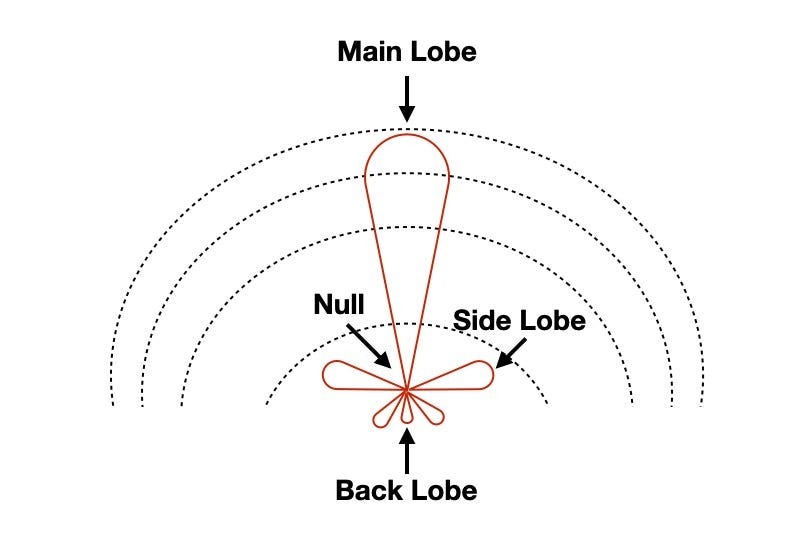
Different radiation patterns can be formed with phased array antennas. In this particular pattern, it is easy to send and receive signals in the direction of the main lobe, harder to communicate with the side and back lobes, and impossible to send and receive a signal in the direction of a null. This is true of communication signals and jamming signals.
If the downlink to the ground station is blocked, Starlink can relay the signal to another satellite by using the Optical Inter-Satellite Links (ISL) that became operational this year. There are 4,600 Generation 1 satellites that don’t have this capability, but the 7,400 Generation 2 satellites can use lasers to transmit data to other ISL-capable satellites which can then send the signal to an unblocked ground station.
The Russians jammed the GPS signals in Ukraine so software updates were created to allow terminal operators to enter in their location data manually. The terminal then ignores the spoofed GPS date it received and can aim the antenna towards the satellites. In addition, the location of the Starlink satellites are precisely known, so their signals can be used as an alternative to GPS signals.
Starlink also uses frequency hopping by jumping rapidly from one frequency to another in the 12.2-12.7 GHz range. All the satellites and terminals change the frequencies at the same time, the pattern of which is encrypted and pseudo-random. The jammer must then jam all the channels in that range, which takes an enormous amount of power, or it must be able to somehow follow the hops in frequencies.
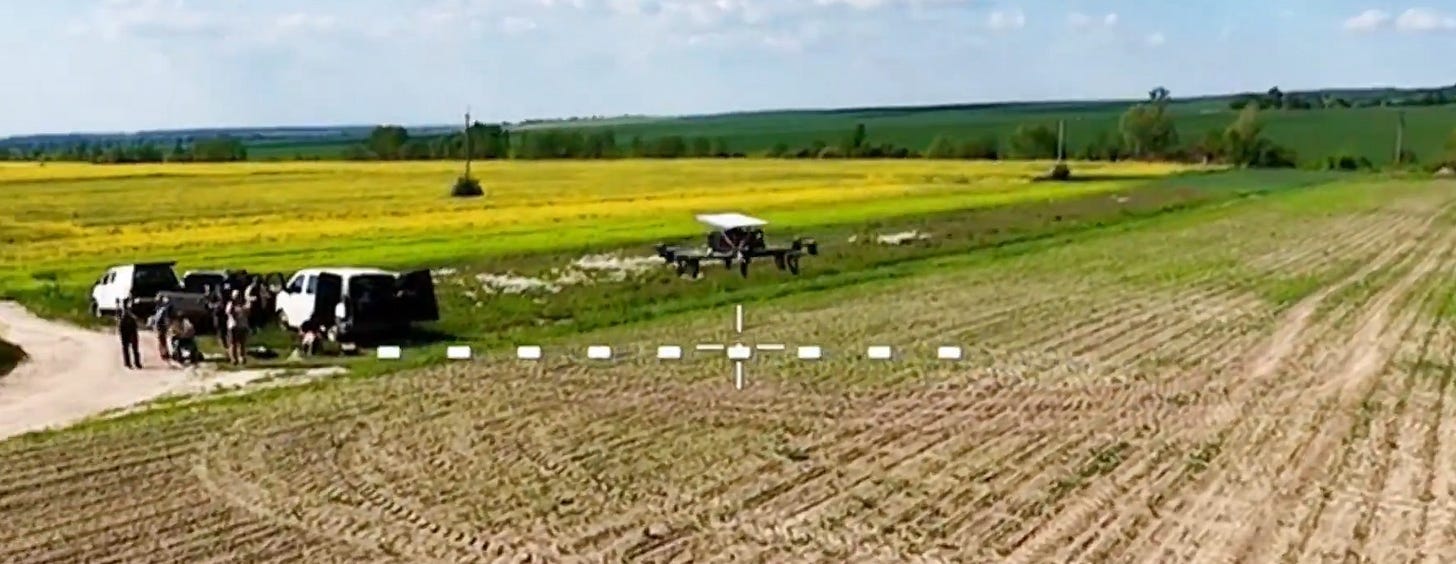
Richard Woodruff is a UK volunteer that started out helping with food, added medical supplies and military equipment aid programs and now helps run Ukraine’s largest volunteer-run drone factory. Their drones destroyed more than $100 million worth of Russian equipment last year. He says that their FPV drone is unjammable with the starlink terminal. Any jamming efforts have to match the Starlink antenna’s exact location and power output and the antenna is on a drone that is always moving.
Ukrainian drones use Starlink terminals to stay in communication as they hunt Russian targets as far as 200 km behind the front lines. That’s an area too big to jam and Russian logistics and command centers are paying the price.
The Question of Syrsky
The 225th and 425th Assault regiments have been accused of being meat regiments, used in attacks much as Russians throw troops into attacks without regard for their soldier’s lives. Because of the growing criticism, a former journalist was transferred from his job in a drone unit to be the spokesperson for the 425th regiment.
You can read what he says here for context. In broad terms, he says the reason they have 10,000 soldiers in the 425th instead of the 1,500-2,000 soldiers of other regiments is because they’re an effective unit and that was the decision of superiors. The reason why they conducted multiple mechanized assaults at Pokrovsk and Kupiansk and lost a lot of vehicles and troops is because they were ordered to conduct these attacks by superiors. The reason they have the highest number of complaints at the office of the ombudsman is because they are the largest unit. He says it’s an honor for different parts of the unit to be sent to the aid of others but it makes the logistics difficult because, among other things, they all receive their drones from the same warehouse, no matter where the units are on the battlefield. The 425th isn’t responsible for any of their losses, they were only following orders, and anyone that disagrees with how the 425th fights the war doesn’t know what they’re talking about. In his opinion, the unit should be praised as a role model.
In truth, the 425th does fight hard in difficult situations. I do not question the fighting spirit of the soldiers. I question the objectives they are assigned and the manner in which they try to achieve those objectives.
There is enough history to show that in a drone dominated battlefield, moving is more dangerous than a firefight with small arms. Russians are more likely to die crossing an open field, moving on a road, or moving along a treeline than engaging Ukrainians in an urban environment. Fighting from house to house is more favorable to the Russians than trying to advance across fields. It does not mean that Ukraine should immediately withdraw from a city once the Russians gain a foothold. It does mean that they need to be very careful and deliberate when engaging in an urban fight because of the increased danger.
There needs to be proper support to prevent infiltration and being cut off. Paths for supplies, medical evacuations and withdrawals need to be maintained. Urban combat is a much more manpower intensive fight than fighting over treelines, and in a drone-dominated environment the goal is to disperse manpower, not condense it. And, yes, when there are no longer any advantages to defending a piece of terrain, whether it is urban or rural, then the defender should withdraw from that terrain. Especially when the disadvantages are clear.
It makes no sense to throw troops into an urban battle, whether with mechanized assaults or helicopter assaults, when any terrain gained will be temporary and the cost in men and equipment is high. That describes the battle of Pokrovsk and Myrnohrad. Small Ukrainian forces were repeatedly cut off. Wounded soldiers that might otherwise be evacuated were killed or captured. Dramatic assaults were filmed as a heroic event when they did not change the outcome and came with a higher cost in men and equipment. And the Russians troops kept moving into the two cities.
Ukraine didn’t create the conditions for victory but they kept fighting the battle anyway. It was no different than Bakhmut. The higher casualties they suffered delayed the inevitable but the extra time they held on to that terrain undermined the ultimate goal of removing Russian forces from Ukraine.
Kupiansk was different. It was still an urban fight but Ukraine created the conditions that made victory possible. With drone and ground forces, they cut the flow of Russian troops entering the city. It was now the Russians inside the city that were cut off, isolated, with no path for supplies, reinforcement or retreat. It was still a dangerous fight that required patience, planning and caution. We’ve seen Columbian troops, once detected by Russian drones, being forced to seek shelter and wait. Their headquarters kept them informed and finally let them know that the skies were clear of enemy drones. And then they resumed clearing out the isolated Russians, carefully, methodically.
That is not what the detachment of the 425th did during one attack at Kupiansk. They were given an objective to clear and decided to take two vehicles and drive to the objective instead of walking there, as advised.
The most dangerous time for Russians when attacking is advancing towards the objective, either through an open field, a road or a treeline. That is true for Ukrainians, as well. The vehicles were destroyed, as many Russian vehicles have been destroyed by drones, and there were casualties among the dismounted troops. The proper decision would have been to try and avoid detection, because once drones detect you, they can persistently attack. Walking under the concealment of trees would have reduced their chances of being detected.
There are a lot of engagements by the 425th that are effective and support achievable objectives. The operations that are poorly conceived and highly visible are the responsibility of their commanders. And their commanders answer to Syrsky.
There used to be other brigades that were sent to stop Russian advances in emergency conditions, but they started questioning Syrsky’s objectives and methods. One commander was relieved right before his unit was sent into Kursk because there was insufficient planning and no achievable objective. Once inside Russia, the commanders of the senior units had to coordinate amongst themselves and their adjacent units because there was no higher guidance and direction. It was just a bunch of units moving in a general direction, and they sustained heavier casualties the further they went.
Supported defensive positions were never established. There were no reserve forces sent to stop Russian breakthroughs. There were Ukrainian counterattacks using mechanized assaults in the open that achieved nothing at the cost of heavy casualties. And as Ukraine was pushed into a narrow, confined perimeter, there was little consideration for withdrawal, despite the heavy toll of vehicles trying to supply and sustain the troops while using only two roads that were easily covered by drones.
It’s a familiar pattern that has long been associated with General Syrsky. He was known to micromanage defenses down the platoon level while failing to sustain the troops that are defending with replacements and reserves ready to counterattack any threatened breakthrough. When breakthroughs do happen, the response from senior leadership is often delayed, because there are no local reserves. And then, as the situation worsens, battalions are detached from dozens of brigades across Ukraine and thrown into the hole. These battalions are far from the logistical support of their own brigades, and there was poor communication and coordination between these suddenly orphaned battalions fighting next to each other. So they did little to stop the Russian advances and lost a lot of troops as they were pushed back. Faced with continuous poor leadership, some soldiers ran away, adding to Ukraine’s manpower issues.
If all those battalions were available as emergency forces once a breakthrough happened, then surely forces could have been available to stop a breakthrough before it happened.
There are multiple cities and pockets that were held onto much too long: Avdiivka, Nevelske pocket, Vuhledar, Kurakhove, Uspenivka pocket, Velyka Novosilka, Kursk, Mynohrad, Pokrovsk.
There were multiple times when there was a breakthrough and there was little to no reaction at the strategic level: Ocheretyne, Niu-York/Toretsk, Vodiane, Pishchane, Tarasivka, Komar, Verbove.
There were multiple times when defenses were neglected so long that they broke: Vuhledar, Terny, Siversk.
One of the best things Ukraine could have done was the establishment of the Corps in early 2025. Not only did this make sense from an organizational point of view, it put more resources in the hands of capable commanders that could now influence a greater portion of the battlefield. With their additional power and proven success, Ukraine could fight rationally, effectively, on larger sections of the battlefield. Syrsky was still the commander, but he no longer had the capability to micromanage the units in the effective corps. The corps commanders could still work towards their assigned objectives, but they could insulate their troops from orders that made no sense, and could even ignore Syrsky on occasion.
Last August, the Russians broke through north of Pokrovsk and advanced in force up to eight kilometers to Kucheriv Yar. This was not a new scenario. Defenses were weakened without any apparent awareness by the higher command, and there were no local reserves to react to any breakthrough. It seemed like another unraveling of a sector that would set the stage for a major Russian advance. But something new happened: The 1st Corps commander was tasked with organizing a response.
He moved quickly, which was also new. Since there was no local reserve, he detached battalions from brigades like Syrsky did in the past. The difference is, he only drew from brigades in the Pokrovsk and Kostiantynikva area, not from multiple units across Ukraine. This reduced the strain on logistics and other sustainment efforts. He assigned specific sectors to each unit and the activities between adjacent units were coordinated. When the threat was contained and the flow of Russian troops into the area was heavily interdicted, the penetration was no longer a threat. It was gradually reduced over four months with low casualties among Ukrainians and high casualties for the Russians.
The Russians in Kupiansk were similarly eliminated under the leadership of the 2nd Corps, which also minimized Ukrainian losses through patience and the methodic execution of detailed planning.
With the rise of the Corps in early 2025, Syrsky lost a lot of influence on front line operations, which was a good thing. He sought to change that with the formation of the Assault Forces in August of 2025. Assault forces as a strategic reserve is a fine concept but Syrsky made sure the commander of the Assault Forces and the assault regiments answered to him without question. By this time, replacements were supposed to be evenly distributed to all the brigades in the army, countering another Syrsky policy of directing them to favored units. Somehow, though, the 425th still grew to 10,000 personnel and the assault forces still had priority on equipment.
And they often fight in the manner of Syrsky.
Syrsky fights like a Soviet commander, using mass, speed and aggression to gain territorial objectives, without regard to the value of those objectives. But Ukraine is inferior to Russia in terms of mass. “A small Soviet army cannot defeat a large Soviet army.” During the Cold War, NATO was inferior to the Warsaw Pact in terms of mass, so NATO multiplied their combat power with better, more expensive equipment, better training, better command and control and increased situational awareness. Ukraine multiplies its combat power through innovation and mass production of inexpensive weapons, communications and situational awareness, and operational agility.
The formation of the Corps has reduced Syrsky’s influence on the details of front line combat. The creation of the Unmanned Systems Forces not only multiplied Ukraine’s power with the dominant branch on the battlefield, it created a sphere of influence free of Syrsky. Common sense rules have been created, such as the distribution of replacements based on need, not a commander’s preference, in order to limit Syrsky’s practices. Just last week Fedorov announced he is removing the general staff from the process of equipping the troops. Fedorov also said that purchases of artillery and mortars should be halted and the money should be used to buy other weapons, such as drones. And the 7th Corps reported its 147th Artillery Brigade has a HIMARS system and has used it already. Stefan Korshak points out that these weapons systems were held at the army level where Syrsky had control of the target list. At the Corps level, front line decisions could be made faster, and faster decisions destroy enemy assets. It is one less thing for Syrsky to micromanage.
The 20th Corps near Huliaipole is not one of the strong corps. That sector has had a problem for 20 months, long before corps were created. There is a strong Ukrainian drone presence in the region that helps reduce Ukrainian casualties and a lot of the assault forces are committed to that region. And it’s had a positive effect. The Russian advances there have been greatly reduced and Ukraine has seen their own advances. In the opening days of the Ukrainian counterattack, a number of Ukrainian vehicles were destroyed as they rode into combat. There’s no indication that there were high losses of Ukrainian infantry, though, and operations are now being conducted on foot. Under these conditions, with that level of support, this is a good use of the assault regiments.
The disorganized and sometimes disastrous combat operations by unsupported units or poorly led units in the past led to a huge level of mistrust within the Ukrainian army and the result was widespread desertions. The Ukrainian front is stabilized now, and Ukraine has the initiative in some sectors. There is still a shortage of soldiers working with ground drones and other occupations. Hopefully, some of those that left can be convinced to help stable, effective units. Their return would increase Ukraine’s capabilities.
Not every detail of Ukrainian military operations is known, but so much has been done to reduce Syrsky’s influence that it does make me wonder which of his continuing contributions makes him so valuable.
Good work as always Don, thank you 👍
Thanks Don, great work