Ukraine Update
Homecoming by Tom Cooper

Hello everybody!
After 2,5 weeks in India, I’m back home - right on time to help roll out the next issue of Don’s Weekly. I’m going to take some time to catch with developments in the Ukraine War, thus will abstain commenting much. Lets go straight to Don and check what’s up.
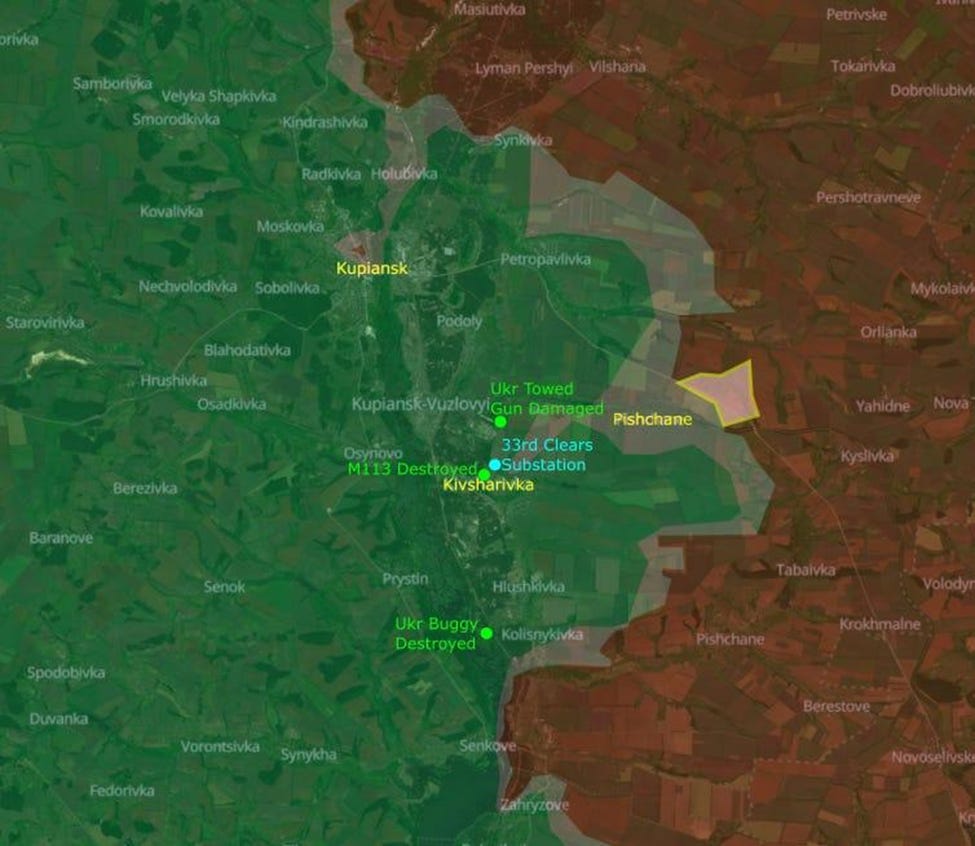
Kupiansk
Russia slowly advances towards Pishchane.
The short and long version of Ukraine’s 33rd Brigade clearing the substation on the eastern side of Kivsharivka. Various Russian targets are attacked behind Russian lines southeast of Kupiansk.
A Ukrainian towed 152 mm gun is damaged.
45 km east of Kupiansk, Ukraine’s Lasar’s Group drone attacked a counter-battery radar. The drone ran out of ammo and the damaged radar was moved 13 km. The drone without ammo rode the vehicle until another drone arrived to complete the job.
Lyman
Izium spent the first six months of the war under Russian occupation. They are now about 27 km from the front and the town decided early to protect the streets and some buildings with drone nets.
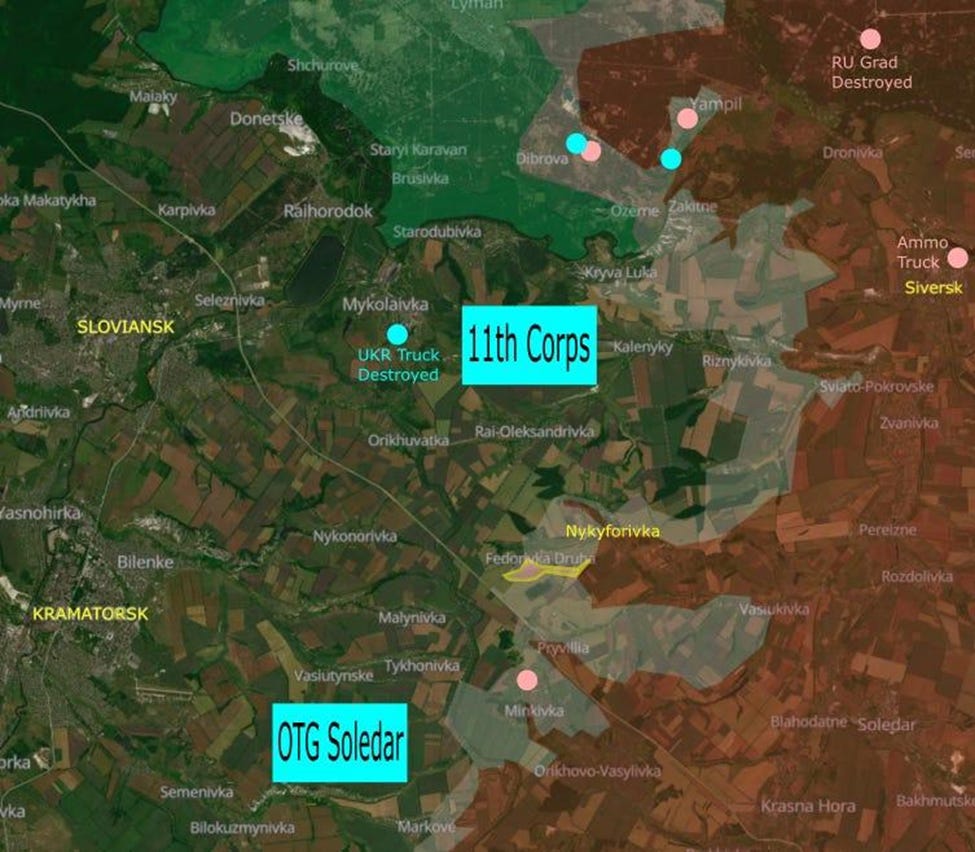
Sloviansk
The Russian advance was slow and focused on the organizational boundary between XI Corps and the Operational Tactical Group Soledar.
A Russian throws a bomb in a house in Nykyforivka.
A Russian ammo truck is destroyed east of Siversk. A Ukrainian truck with a cage is attacked.
Yevgeny Nikolaev, the commander of a drone unit and the person behind the Wargonzo propaganda site, was killed by a drone while trying to evacuate Russians who never should have come to Ukraine.
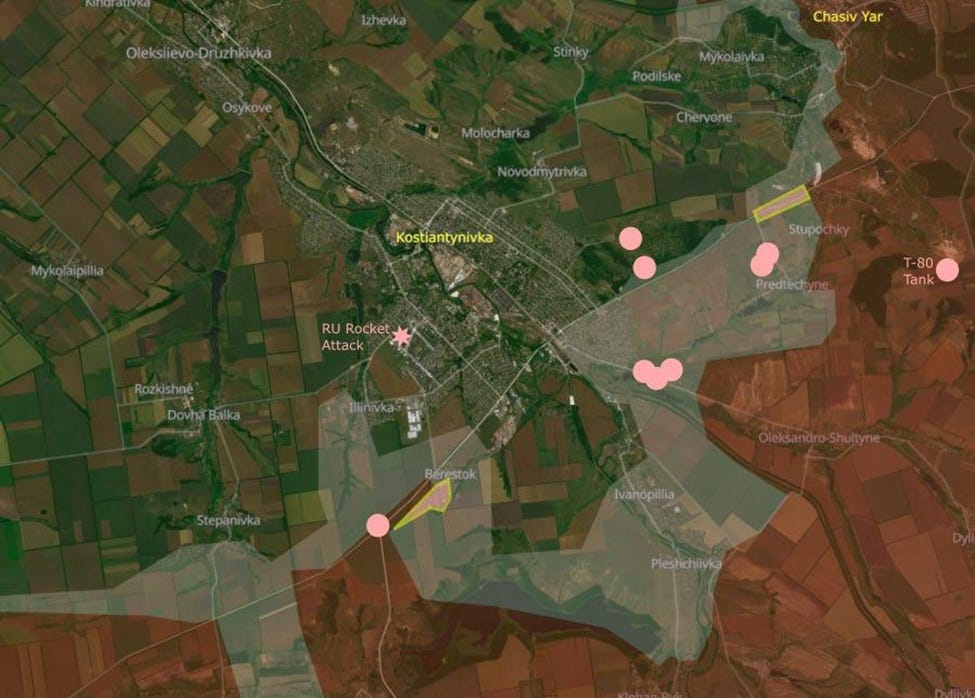
Kostiantynivka
Twenty months ago Ukraine conducted a unit rotation on this axis and Russia took advantage and began a slow advance towards Kostiantynivka - which, back then, was 21 km away. Russia is continuing that slow advance.
A Russian T-80 tank that was in an open field on a cloudless day was somehow detected and attacked.
A Russian rocket attack in Kostiantynivka.
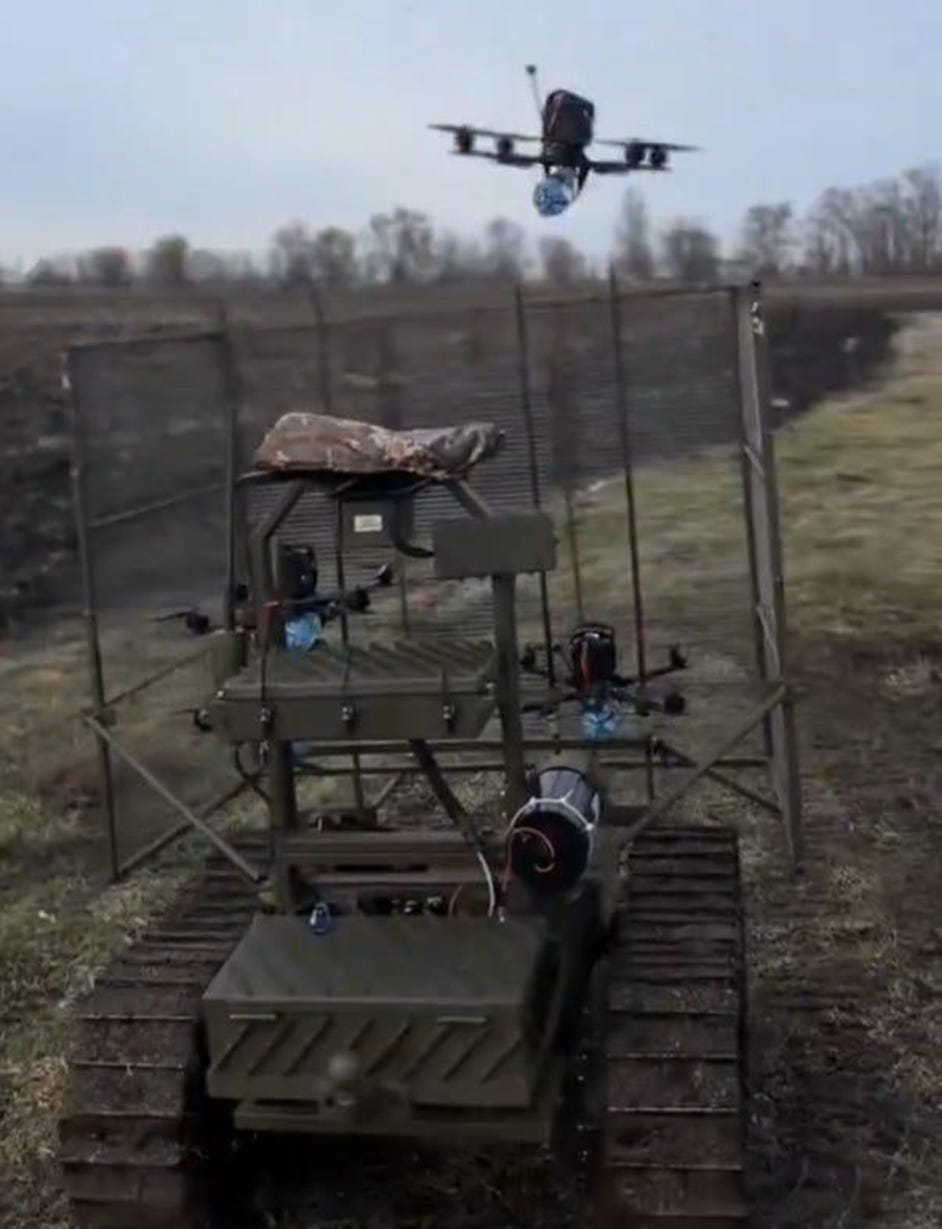
A couple weeks ago, Ukraine’s 100th Brigade ground drone just delivered supplies to a front line position, and on the return trip saw troops from another brigade trying to evacuate one of their own on a hand cart. After communicating through a speaker, the wounded soldier was transferred to the ground drone and brought to the rear.
Another Ukrainian drone evacuates a wounded soldier and a dead soldier. Two FPVs hit the ground drone on the way to the front line. On the way back, the drone hits a mine and the wounded soldier is thrown off the drone. He’s loaded back on and the drone is able to keep moving.
A Ukrainian ground drone is destroyed in Kostiantynivka. While unfortunate, it is much preferred over destroying a pickup truck with a human driver.
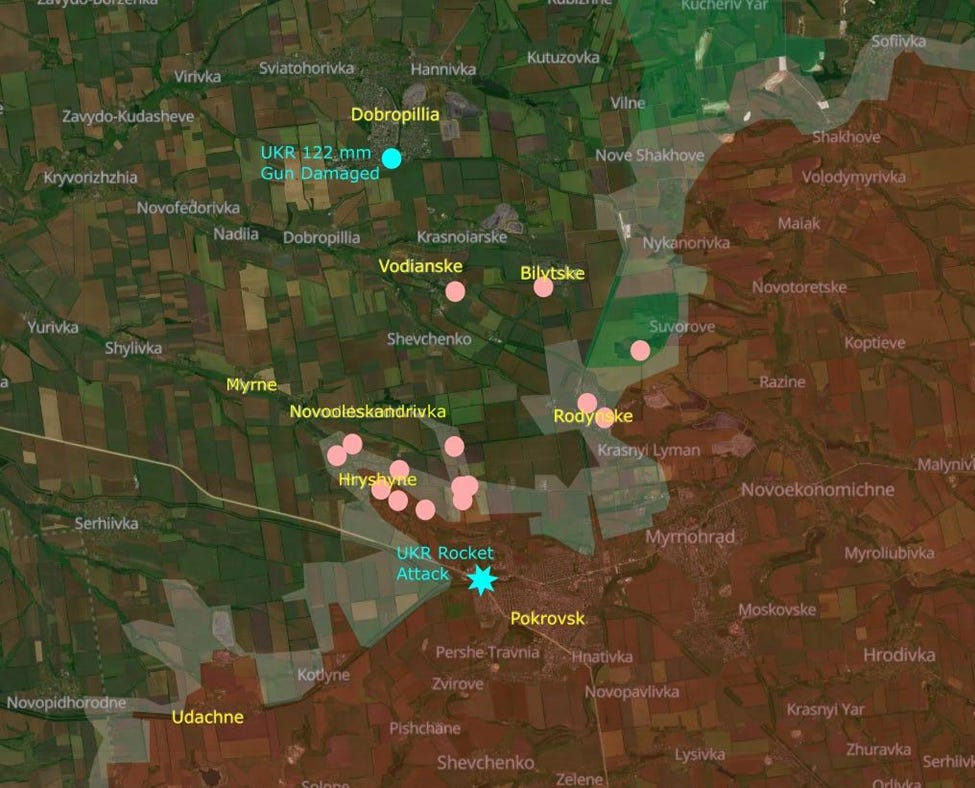
Pokrovsk
The sector through Rodynske is porous, but infiltrators are still tracked down 7 km away and eliminated. One reason why Russia is pushing so hard through Hryshyne to Novooleksandrivka and Myrne is because the trees and buildings provide cover on this route.
A Ukrainian rocket attack hits western Pokrovsk.
Ukraine’s 25th Airborne ground drones deliver supplies, evacuate wounded, survive drones and are recovered when damaged.
Two Russian trucks were transferring ammo when an MLRS strike hit the adjacent building. Some personnel dropped and others walked away.
Novopavlivka
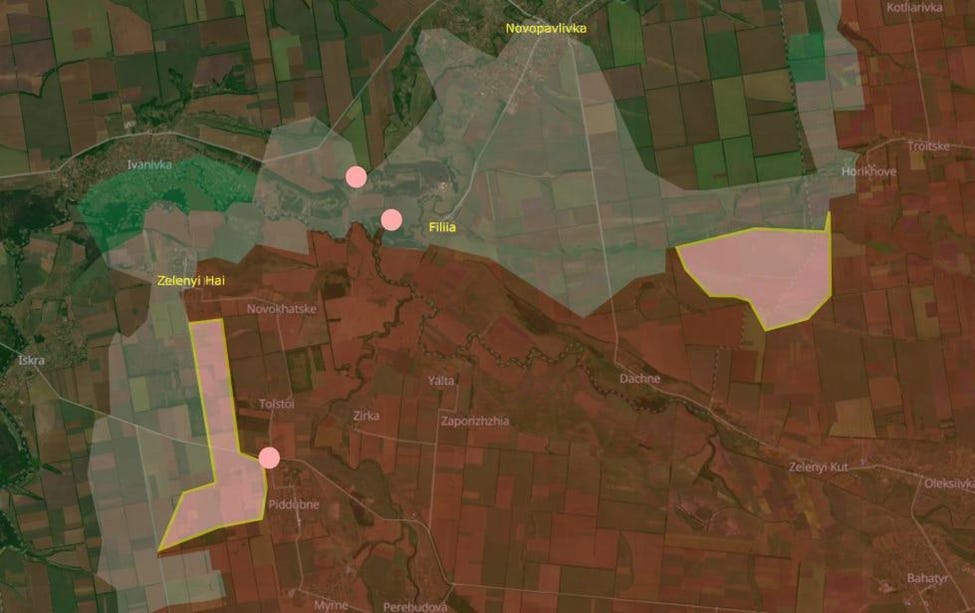
Russia advanced 1-2 km in parts of this sector.
Russia shells Novopavlivka.
Huliaipole
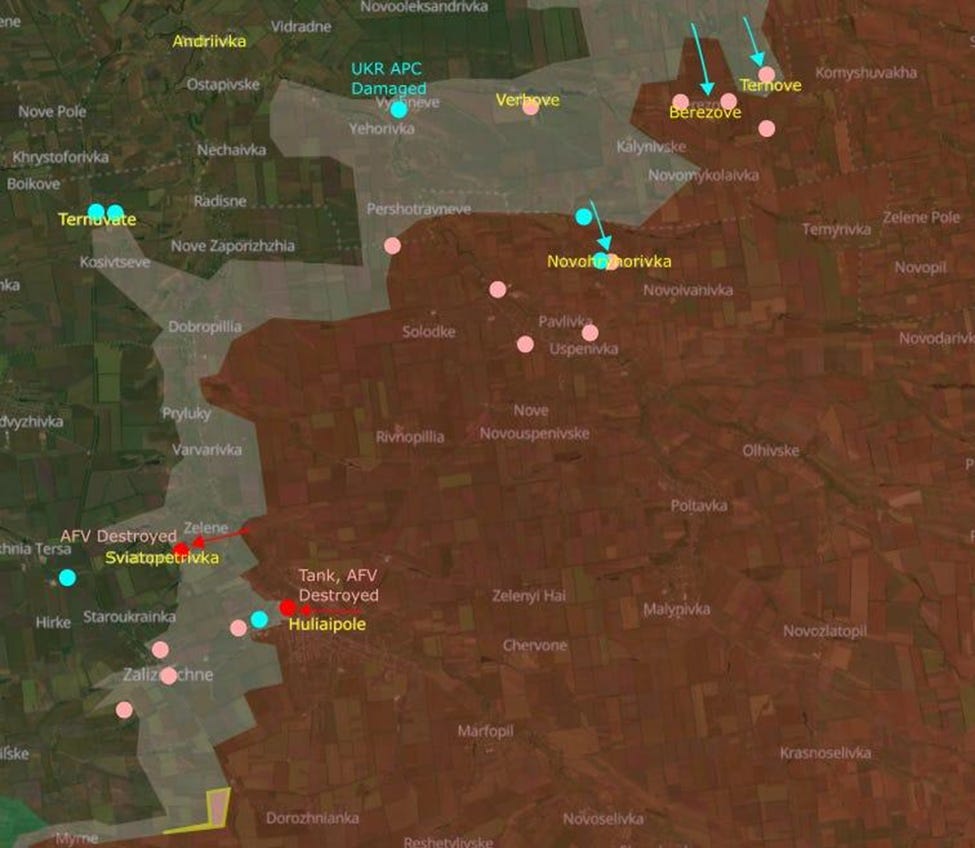
The Russians are concentrating more forces in Huliaipole and have increased their assaults in the sector. A tank, an armored vehicle and two quad bikes were destroyed in Huliaipole and the infantry that dismounted was attacked.
There was fighting in Novohryhorivka. Russians are attacked south of Novohryhorivka.
The 225th stopped a Russian assault in Sviatopetrivka.
Ukraine’s 92nd Brigade evacuates two wounded soldiers by ground drone.
Zaporizhzhia
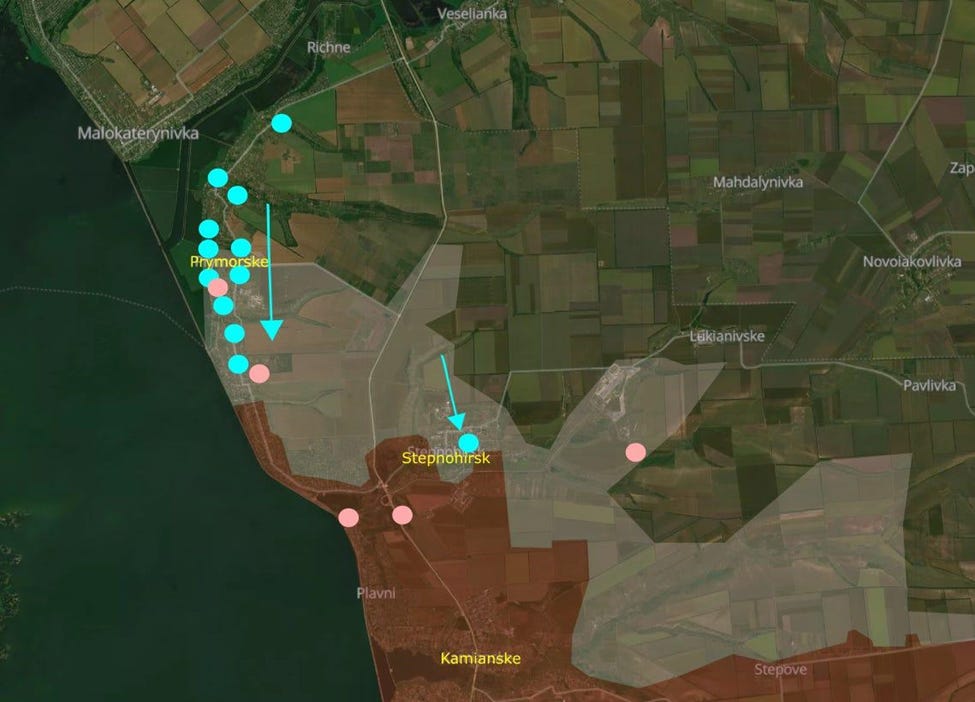
Ukraine clears Prymorske and continues to press south.
***
Occupied Territories
Three Pantsirs are among the targets hit in Crimea. Five radars were hit. An Iskander launcher was attacked.
A Lasar Group drone attacked and damaged a counterbattery radar in Luhansk. The crew lowered the radar and drove away. Out of ammo, the drone landed on the vehicle and provided the location of the target while a new drone arrived to finish the job.
There have been so many losses of radars and air defense systems in Crimea that Russia is considering changing the leadership of the 31st Air Defense Division.
Two locomotives on a train were attacked near Tokmak. SBU also hit 19 air defense elements, an ammo depot, warehouses, four drone workshops and other targets.
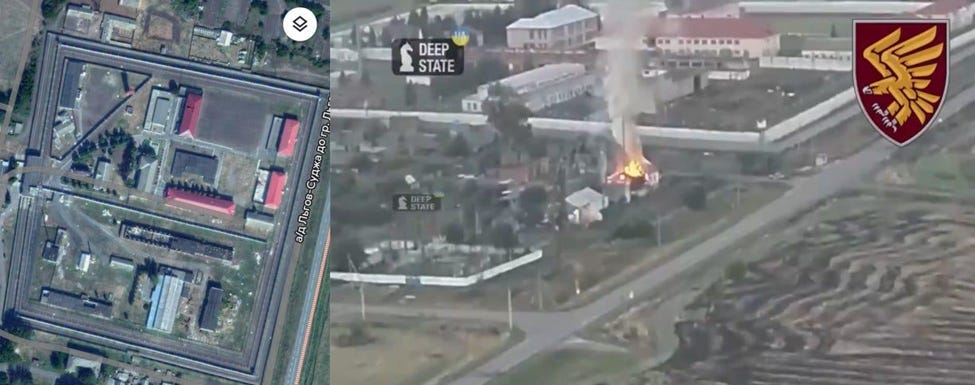
Russia held Ukrainian female prisoners in Correctional Colony No. 11 in Mala Loknia in Kursk until the Ukrainian invasion forced an evacuation. The women had to undress and sing the Russian national anthem, learn poems about the USSR and sing songs from WW2. Guards would use stun guns and dogs, and the female guards were sometimes more cruel than the male guards. They were forced to do physical exercises without food and could not sit during the day. Russian prisoners and male Ukrainians were also in the prison. The guards and prison administrators wore balaclavas to conceal their faces.
Last week, a car blew up in occupied Donetsk, possibly with the body of the former warden of Correctional Colony No. 11 inside.
Russia
155 Russian billionaires with a combined wealth of $696.5 billion now have more money than the rest of the Russian population, which own $587 billion.
A Ukrainian reconnaissance drone recorded the attack of 7 Storm Shadow missiles on an electronics plant in Bryansk, 110 km from the border. Satellite imagery indicated severe damage. The second-largest factory for microelectronics produced components for Pantsir and S-500 air defense systems and Kalibr cruise missiles. Six workers were killed and 42 were wounded. This was a significant target that has been heavily damaged. Two weeks ago, the director of the factory said, “We are currently the second largest microelectronics company in Russia. You need to understand that if we were to suddenly disappear today, a number of [Russian] military products would cease to exist.”
An oil depot in the Tikhoretsk district of Krasnodar Krai was hit. The Afipsky refinery was damaged.
There have been six attacks on chemical plants in the last three weeks, including an attack on the KuibyshevAzot chemical plant and a repeat attack on JSC Metafrax.
The Kosogorsky metallurgical plant was on fire.
The 429th Brigade hit five Pantsirs around Belgorod.
The railway ferry Slavyanin and the ferry Avangard were damaged.
Ukraine says Russia is providing drone components to Iran.
Because Russia’s neighbors shut down rail traffic with Russia, Russia is providing Kaliningrad with $65 million in subsidies for sea transport.
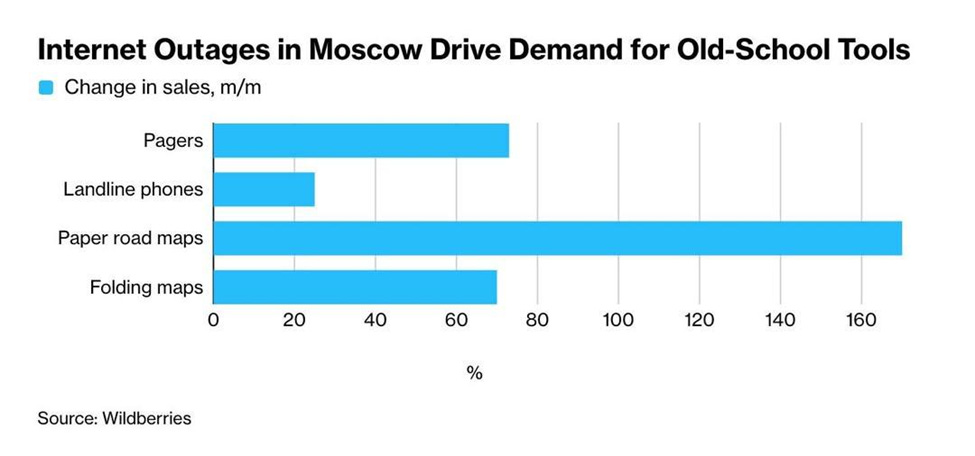
The internet in Moscow has been shut down for more than a week for security reasons. Sales of pagers, paper maps, walkie-talkies and telephone landlines have increased. Business losses could be $12.5 million a day.
An upscale taxi service in Moscow was banned for refusing to provide its passenger data to security services. Foreign taxi drivers were 60-70% of the workforce but are now banned from operating taxis. The taxis themselves must now be manufactured in Russia despite costing more and providing less. As competition is eliminated and the monopolies charge more, passengers and drivers are increasingly negotiating trips and prices on Telegram. The passengers pay less and the drivers earn more, replicating the illegal taxi services in the 90s.
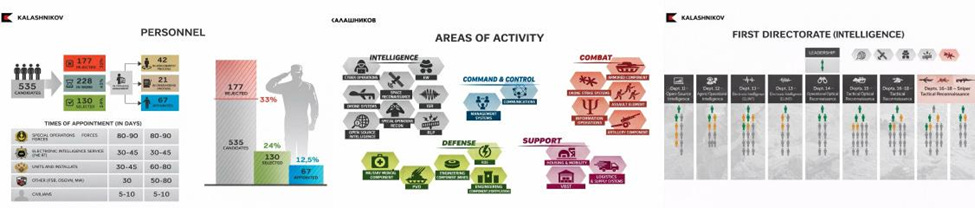
Unit 29155 was responsible for a botched coup attempt in Montenegro, assassinations and bombings. Dozens of its operatives were identified because the passports issued to them were all part of a numerical sequence. Because of their failures, Center 795 was created as a private company under the cover of Kalashnikov and Rostec. It was tasked with a wider range of missions but instead of having thousands in its employ it had 500 agents. Its most sensitive section handled human agents abroad and it was mostly staffed by veterans of Unit 29155, whose failures led to the creation of Center 795. One of these handlers travelled under his own name and spoke to a Serbian agent through Google Translate. The FBI monitored those conversations after obtaining a warrant. In March, 2025, the handler was arrested in Columbia.
Ukraine
In a meeting with Trump in August 2025, Zelensky and a Ukrainian delegation described how Iranian drones had improved and offered interceptor drones to be used in anti-drone centers in Turkey, Jordan and the Gulf countries. Ukraine was to provide the technology and expertise and the US would finance the production expansion of drones and grant access to American weapons. Ukraine believed that 20 million drones could be produced and provide the US with dominance in unmanned systems. Trump turned them down but asked for help after the war started. Trump’s two oldest sons used the money they accumulated through corruption to start a company that plans to buy Ukrainian technology and sell it to the Pentagon, completing a cycle of corruption. It takes about six months to train interceptor pilots so if the program was set up right away they might have been ready for this spontaneous war.
1,597 railway cars belonging to sanctioned Russian rail companies were seized in 2022. Ukraine will now use them to move military supplies.
Supply Chain Security
In 2023, China started to impose restrictions on drone exports to Ukraine. They expanded those restrictions in 2024 and have always favored Russia in providing supplies. Relying on China to provide weapons and materials is a risk for Ukraine, and one that is difficult to avoid.
There are Ukrainian drone companies that are now able to build drones without purchasing any parts from China. These alternate sources are more expensive so the inexpensive Chinese parts are still purchased, but they at least have options should China refuse to sell them materials and components. Many of the components that they buy from non-Chinese sources have Chinese materials in them. All of Ukraine’s drones are assembled domestically and 38% of the components come from China.
Two of the China-free drone companies were selected to compete for a US defense contract.
United Defense Drones (UDD) started production in 2023 using Chinese parts. A year later it was producing its own carbon fiber frames and antennas. If the antennas were a millimeter off, they wouldn’t be able to function properly, so the work had to be precise. They now make 15,000 antennas a day. By 2025, they were making their own flight controllers, speed regulators, radio modems and video transmission systems. They buy cameras from another Ukrainian company that imports them from Europe, but they are making progress on building their own cameras.
China still remains part of their supply chain, though. UDD builds their own carbon fiber frames but they import the carbon from China because it’s cheaper. Most batteries are produced by China, as well, because of their control of the lithium and rare-earths market. Over the decades, China made themselves indispensable and it will take time to find alternatives to China.
Diplomacy
The US blockade on oil deliveries to Cuba led to long term power outages and deteriorating living conditions. Protests are being reported and some protests escalated to violence that is directed at the government. Five years ago there were widespread protests about living conditions.
Sweden seized the Sea Owl I shadow fleet tanker.
Israel asked Ukraine for help to intercept drone attacks. Ukraine agreed to do so. Iran, which provided Russia with its first Shahed drones, declared that Ukraine is now a target. 11 countries requested Ukraine’s aid.
The current US administration values loyalty over competence. National security posts are not fully staffed and the processes to identify the issues, objectives and likely outcomes are not utilized. Decisions are being made by amateurs based on their own assessments. The former ambassador to Russia says, “Reporting tells us that there is no real National Security Council-led inter-agency process operating in the Trump administration. They don’t even have a full-time NSA! So that probably explains why (1) the mission of the war is ill-defined, (2) the comms roll-out was a mess.”
The US and Israel started the war with Iran but they cannot end it unless Iran agrees to end it. The Iranian regime is showing no signs of falling. Their plan is to endure the attacks and cause enough economic pain to the world that Arab states and other nations would pressure America would not be eager to attack them again. Iran sees not point in diplomatic talks with the US because the last two times they were engaged in talks they were attacked. Higher oil prices will mean more destruction in Ukraine, and the expenditure of air defense missiles in the Gulf means there will be fewer to send to Ukraine. It remains to be seen if the deployment of Ukrainian drone teams will provide a benefit to Ukraine in terms of equipment and joint ventures in production.
Trump insists it does not need Ukraine’s help against drones, saying, ““We don’t need their help in drone defense. We know more about drones than anybody. We have the best drones in the world, actually.” Meanwhile, an Iranian drone takes a leisurely tour over a US base in Iraq.
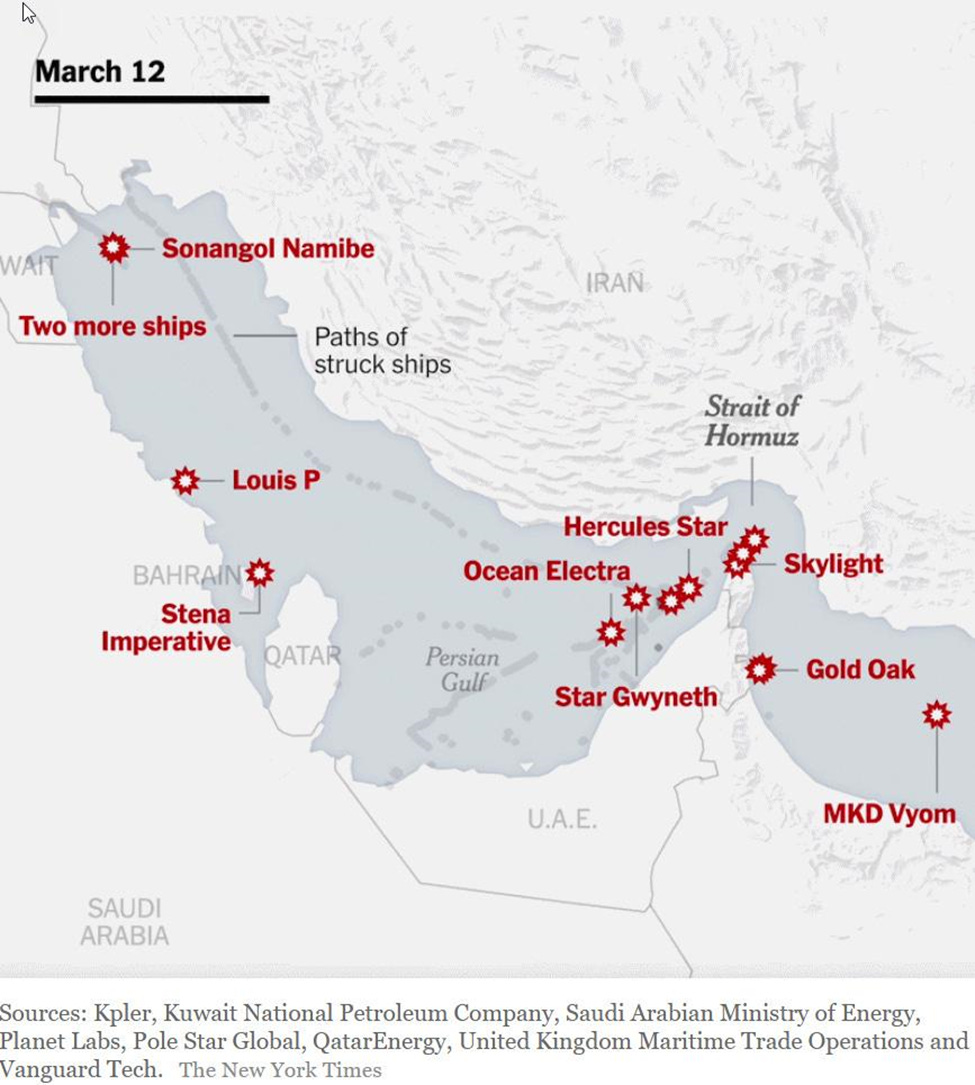
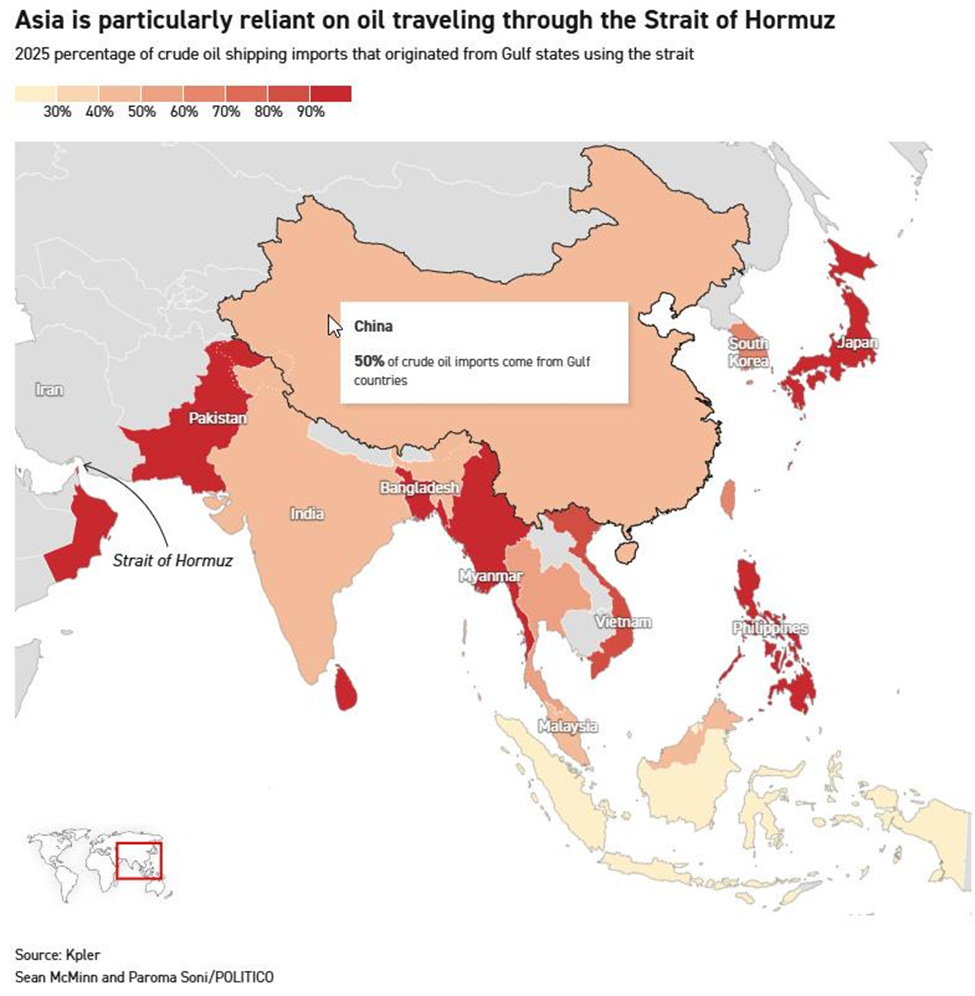
Iranian tankers still travel through the straight on the way to China. They are delivering 100,000 barrels a day more than before the war. Iran is considering letting oil tankers through if they bought the oil with Chinese yuan. Russian ships trade oil in rubles or yuan. Trump is considering seizing Kharg Island, through which 90% of Iranian exports flow.
Along with 20% of the world’s oil, one-third of the world’s fertilizers come through the Strait of Hormuz. Urea, sulfur and phosphates are used in spring plantings to increase the yield of crops. With the reduction of fertilizer, crops will be smaller and prices will be higher.
The only commercially feasible source of helium is linked with the extraction of natural gas. The largest helium reserves are the US (20.6 billion cubic meters), Qatar (10.1 billion m3), Algeria (8.2 billion m3), Russia (6.8 billion m3) Canada (2.0 billion m3) and China (1.1 billion m3). With regards to annual helium production, the US leads with 75 million cubic meters, followed by Qatar (60 million m3), Algeria (9 million m3), Russia (5 million m3), and Australia (4 million m3). Helium is used for weather balloons that collect data, deep-sea diving mixtures, welding and manufacturing, pressurizing liquid-fueled rocket tanks, supercooling MRI scanners, and creating a protective heat-managed atmosphere for growing silicon crystals for semiconductors that are 5 nm or smaller, and making fiber optic cables. Qatar produces 38% of the world’s helium. South Korean chipmakers rely on Qatar for 64% of its helium supplies. Taiwan’s TSMC says their supply is stable but other chip makers have a three month supply.
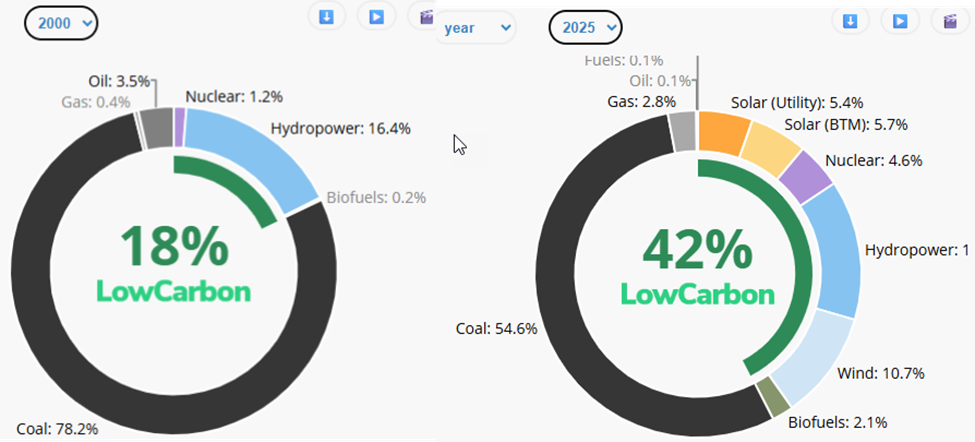
China is the world’s second largest consumer of oil behind the US, and the world’s largest importer of oil. China imported a record amount of oil in 2025 to build up its reserves. Iran sent 87% of its oil to China and Venezuela sent 55% to them. That amount represented 13.5% and 3.8% of China’s imports, respectively. After the US/Israeli attack on Iran last June, China continued to buy cheaper Iranian oil but began diversifying its sources. Overall, China relies on oil for 18.2% of their energy needs and 70% of the oil it uses comes from imports. If it continues to consume oil at the 2025 levels it has enough reserves for 104 days.
The Russian LNG tanker that was reported sunk last week is actually still afloat and awaiting a tow.
It would take about 2,000 oaks to build a warship in the early 19th century, so in the 1830s, Sweden planted 300,000 oak trees to be used for future production of warships. In 1975, Sweden’s Chief of Navy was supposedly informed that the first oaks were ready. The navy declined the offer of timber. Similar stories were true in other nations, such as Trafalgar Oaks in the UK, the Naval Live Oaks Reservation in the US, and in North Zealand and other areas of Denmark. In Lithuania, they are planting trees for military use again, this time as defensive terrain against a potential Russian attack. Finland and all three Baltic states are also restoring former wetlands as natural obstacles to Russian advances, with the added bonus of being a very effective CO2 storage site.
Hungary submitted a bill to justify the seizure of the money of Oschadbank until the investigation of their claim of money laundering is completed. If there were grounds to make the seizure then it wouldn’t need to be justified afterwards. A Hungarian minister said the money was taken because the Druzhba pipeline Russia damaged hasn’t been repaired yet. The Ukrainian employees were unarmed and were apprehended by Hungary’s anti-terrorism unit with automatic weapons and grenade launchers. The employees were handcuffed, blindfolded and denied medical treatment. They were only addressed in Russian. When they were released, their phones and other personal items were not returned.
There may be more than one reason why Hungary seized a Ukrainian interbank transfer. A friend of Orban owns Criterion, a firm that monopolized interbank transfers in and through Hungary. In 2024, Criterion handled €15 billion and reaped massive profits. Oschadbank decided to transport the funds independently. As soon as the Ukrainians drove past the location where Criterion became involved, the state police stopped and detained them.
Equipment
A Polish and Ukrainian company are starting a joint venture to produce self-propelled Bohdana 155 mm guns. The Polish company will own 51% of the venture. This will allow Bohdana’s sale to other countries, which cannot happen with weapons manufactured in Ukraine. The low production costs allows competitive pricing, which might be a deciding factor for some customers seeking to replace Soviet-era howitzers.
Some more statistics on Ukraine’s ground drones: Dozens of companies now produce them and they built 2,000 in 2024 and 15,000 in 2025. Ground drones move 80% of the logistics for the 3rd Assault Brigade and account for 90% of the supplies in the Pokrovsk area. The drones can clear 7,000 square meters of mines a day and can lay mines, place obstacles and move EW and surveillance gear into position.
Ukraine develops, tests under wartime conditions and modifies weapon systems faster than nations operating under peacetime conditions. It is possible that they will have a laser that can destroy Shahed drones in 1-2 years while the US with all its resources are probably five years from deploying such a weapon.
Fire Point began by using decommissioned engines for the Flamingo missiles. This allowed them to speed initial production but a disadvantage was that the engines were most efficient at 6-10,000 meters and the Flamingo was intended to fly at 50 meters. The company says they have now completed development of their own engine designed for low-altitude flight. The actual production of the engine should begin in early 2027. Fire Point currently produces 80 of 82 parts for the engines of the FP1 and FP2 drones.
Drone Statistics
105,200 Russian targets were hit. 4,200 of them were Russian drone positions. Russian drone positions are closer to the front lines so they can extend their range but it also makes them more vulnerable and they suffer more losses.
Russia is producing 19,000 FPV drones a day and are creating more drone units. They plan to have 101,000 servicemen operating drones by April 1st.
Ukraine is forming platoons that are dedicated to intercepting Russian drones. The tasks of reconnaissance, strike and interception require different skill sets and specialization will increase effectiveness. They will be equipped with electronic anti-drone rifles, EW equipment, net launchers and other equipment. There are already interception teams for Shahed drones, but these teams will focus on FPV, quadcopters and strike drones. Russian drones hit Ukrainian troops, but they are not easy to detect because they minimize their movements. Ukrainian logistics are hit much harder because they have to move, and there are a limited number of routes they can take.
Evolution on the Battlefield
Most of the drones used early in the war were hobby drones that used the 2.4 GHz frequencies for controlling the drone and 5.8 GHz for the video feed. These were easily detected and jammed by Russian EW devices, and Ukraine could do the same to Russian drones. To evade the jammers, Ukraine shifted to non-standard lower frequencies, forcing the Russians to search a wider spectrum to detect the signals and then jam them. The handheld detection devices for the infantry also had to be expanded.
Other methods to avoid jamming were implemented, as well, such as frequency-hopping, redundant communications, AI navigation and targeting, and fiber optic cables, first used by the Russians. Higher power signals were used to overcome jamming, and directional antennas reduced signal reception from the direction of enemy jammers.
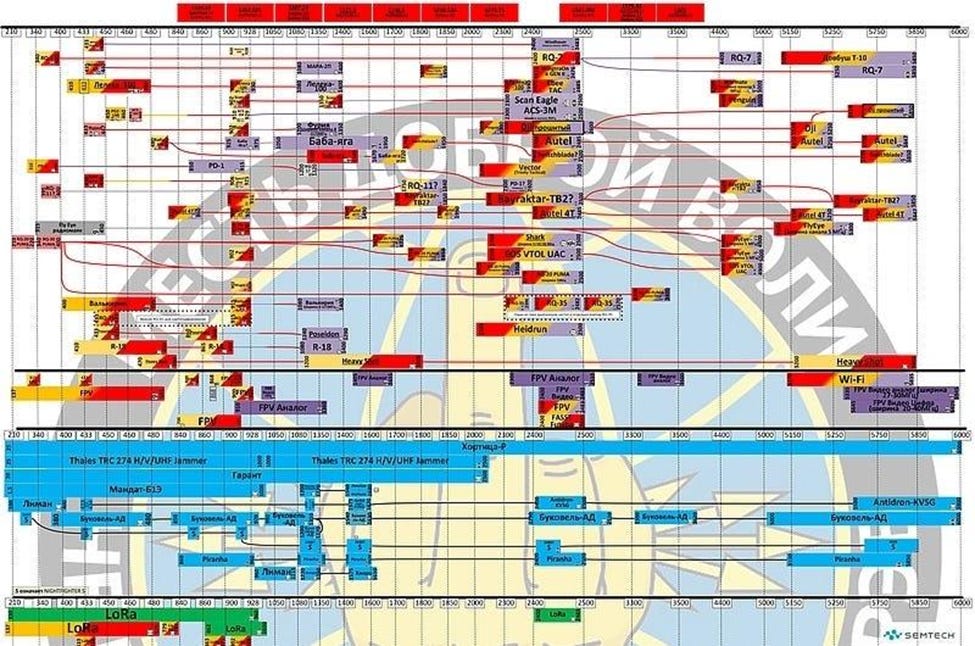
The Russians adapted to detecting and jamming lower frequency signals, so by last summer, Ukraine started using transmitters and antennas operating at the higher frequencies of 6.7 or 7.2 GHz. Some of the Russian equipment could monitor these frequencies with a software upgrade but other equipment were simply unable to operate on those frequencies.
There were downsides to operating at the higher frequencies. Extremely low frequencies use antennas that can be 23 or 45 km long and the signals travel long distances and can penetrate a certain amount of terrain. Signals could be sent to underwater submarines. As the frequencies become higher, the range is reduced and it is easier for terrain to block the signal. Because of this, an unobstructed line of sight is needed between the transmitter and receiver, and signal repeaters are needed to extend the range. On the other hand, more data can be sent across higher frequencies, and there are more channels that friendly drones can use and enemy jammers have to search and block.
But electronic warfare is never static. It is constantly evolving, moving forward and backtracking. For every counter, there is a counter to that counter. Russia recovered Ukrainian drones operating on the even higher frequencies of 8.5 GHz, and Ukrainian FPVs are using frequencies in the 10-12 GHz with directional antennas in the 9.5-12 GHz range. Russia must not only adapt their equipment to this higher range, they still have to monitor and jam the low- and medium-ranged frequencies, as well.
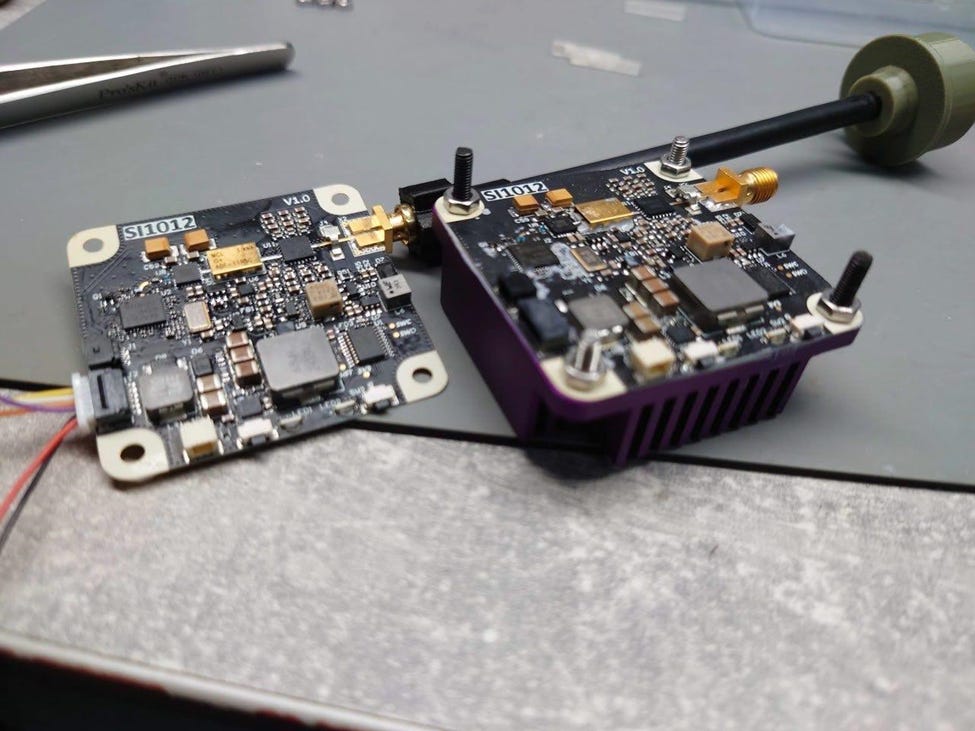
The transmitters for these frequencies are more expensive and need more power, and the antenna has to be extremely precise at the higher frequencies. Price is an issue in this war of attrition. A 6 GHz test instrument costs three times what a 1.2 GHz instrument would cost. The high-frequency antennas can add $350 to the price of the drone.
EW units cannot jam all frequencies all the time. As widespread as they are, they are limited by range, so the EW units have to be deployed across the length of the battle lines, and they have to monitor an ever-widening spectrum of frequencies. Once they detect a frequency being used by the enemy, they can attempt to jam it but the operation may not be successful due to directional antennas, a stronger drone transmitter, frequency hopping, or a variety of other counter measures.
Since Ukraine can now operate on a wider spectrum of frequencies, they can now operate more drones in the same space at the same time. That requires a lot of manpower and a lot of coordination to make sure the different units don’t use the same frequencies.
The coordination comes from the Mission Control system that unifies planning, execution and reporting for all drone operations across the entire country. This system tracks the frequencies that Russia is jamming at different locations and allows drone commands to deconflict and coordinate operations in the same battlespace. The Mission Control system itself is part of the DELTA battlefield management system that coordinates sensors and combat systems in the air, land, sea, cyber and space domains.
And all the data and planning that is being conducted at the battalion level can be seen and tracked at the brigade, corps and army level. This provides commanders information in addition to the human channels. They can see which drones, which tactics and which units are effective and take measures to scale the successes and correct the failures.
The ability to connect the data throughout the army comes with a security risk, and Ukraine mitigates that risk on a least-privilege basis. Brigade commanders can only see brigade-level data and corps commanders see corps-level data. If a drone team’s system falls into enemy hands, the Russians will only see the data that the pilot saw. They won’t be able to access the system itself.
Ukraine just added a radar tool to the DELTA system that allows service members to track and visualize air threats in their area and it can operate without an internet connection. The next module they plan to add to DELTA will focus on artillery and mortar units. All of this was developed on a cloud infrastructure that NATO developed, and NATO provided $40 million to equip Ukraine with satellite communication hardware, secure digital services and support for DELTA and other management systems.
Ukraine will continue to find ways to keep drone operations viable and Russia will continue to adapt and counter these developments. Ukraine, in turn, will eventually counter the Russian adaptation. These evolutions provide Ukraine with short periods of advantage, but the command and control systems enable Ukraine to Observe, Orient, Decide and Act (OODA) at a faster rate than Russia. Russia chose a different model for their military and will never be able to replicate what Ukraine is doing with the same degree of success. This means Ukraine’s OODA loop will always be smaller than Russia’s OODA loop, allowing them to understand the battlefield situation and act on that understanding while Russia is still gathering data. That is a huge advantage.
There will always be a need for infantry on the front line, but if Ukraine can minimize the number of troops on the front line, and minimize the duration they are exposed to enemy observation and fire then their casualties can be significantly reduced. The way Ukraine is doing that is by increasing their use of aerial and ground drones. They are replacing their troop density of infantry on the front line with drone crews in the rear.
The production of drones used to be a limiting factor but that is increasingly becoming less of a factor. In 2023, Ukraine produced 800,000 drones. They produced 2 million in 2024 and 5 million in 2025, 4.5 million of which were FPV drones. They plan to produce 7 million in 2026. An increasingly significant issue is the lack of manpower to pilot and support the drones for 24-hour operations. That is one of the issues the Minister of Defense will have to resolve.
The designs of the drones change, the frequencies they use expand, the tools to manage information are developed, the production levels of the equipment increase and the doctrine and tactics evolve to adapt to the capabilities and battlefield conditions. AI, anti-drone technology and other factors will drive future changes. If Ukraine can minimize the exposure of their troops they will reduce their own casualties. Ukraine is also extending the kill zone and punishing Russian logistics. As long as Russia continues to attack they will suffer high casualties, and Russia has to attack.
Excellent work as always Don, thank you 👍🏻
Thanks mr hill fornthis dossier!