The War on Logistics

Creating Obstacles and Using Time as a Weapon
One of the goals, for both Ukraine and Russia, is to prevent the enemy units from receiving replacement soldiers or supplies, such as ammo, fuel, water and food. Destroying supplies is preferred, since those supplies will never be a threat again. Blocking supplies is the next best thing because it prevents an enemy unit from receiving supplies, but the supplies still exist and can be sent by a different route or method, or used somewhere else. Yet even delaying the arrival of the supplies is useful because if a unit receives ammo quickly, it can expend ammo quickly. If a unit receives ammo slowly, then it has to slow down its rate of expenditure or it will run out of ammo.
Delaying drone supplies is immediately useful. Delaying fuel means vehicles and generators have to be used less often. Delaying food and water may not mean much for a day, but if the soldiers only receive half as much food and water as they need over a week their ability to function degrades.
Near the front lines, Ukraine is creating obstacles to delay, block and destroy Russian infantry and vehicles. These front line obstacles need to be built, but in the logistical war in Russia’s rear areas, Ukraine is taking advantage of the rivers and creating obstacles by damaging and destroying bridges.
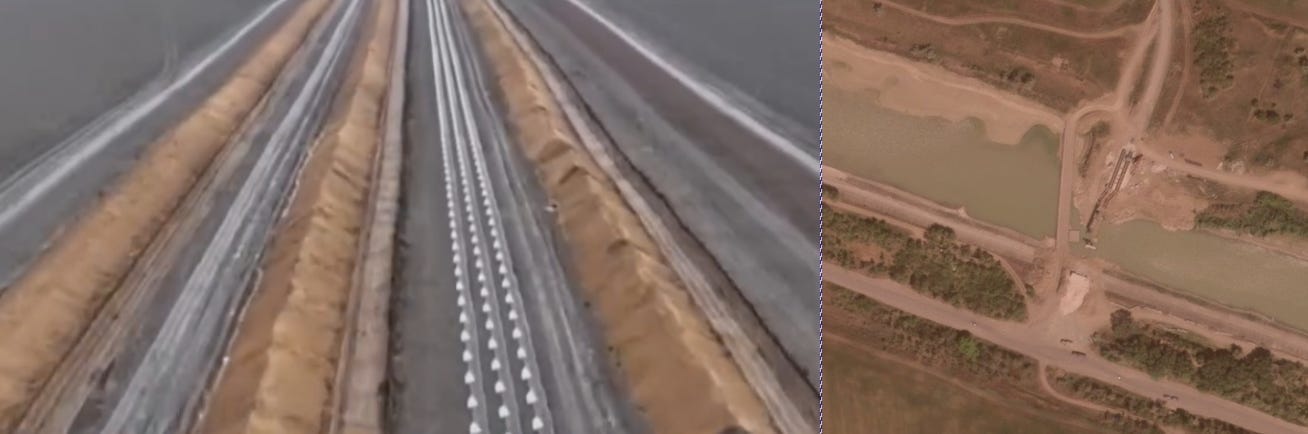
(Left) Obstacles on the front line delay enemy personnel and equipment and make it easier to destroy them. (Right) Logistical obstacles, just as destroyed bridges, make it harder for personnel and equipment to reach the front lines and makes it easier to destroy them.
If a route is broadly defined as roads passing near or through Armiansk, Chonar, Henichesk and Kerch, then Ukraine has not blocked any routes yet. Blocking is a persistent state that requires lack of action on the part of Russia or constant reaction from Ukraine. If the vehicular and rail portions of the Kerch bridge were theoretically destroyed and Russia was unable to repair it, then that route would be blocked.
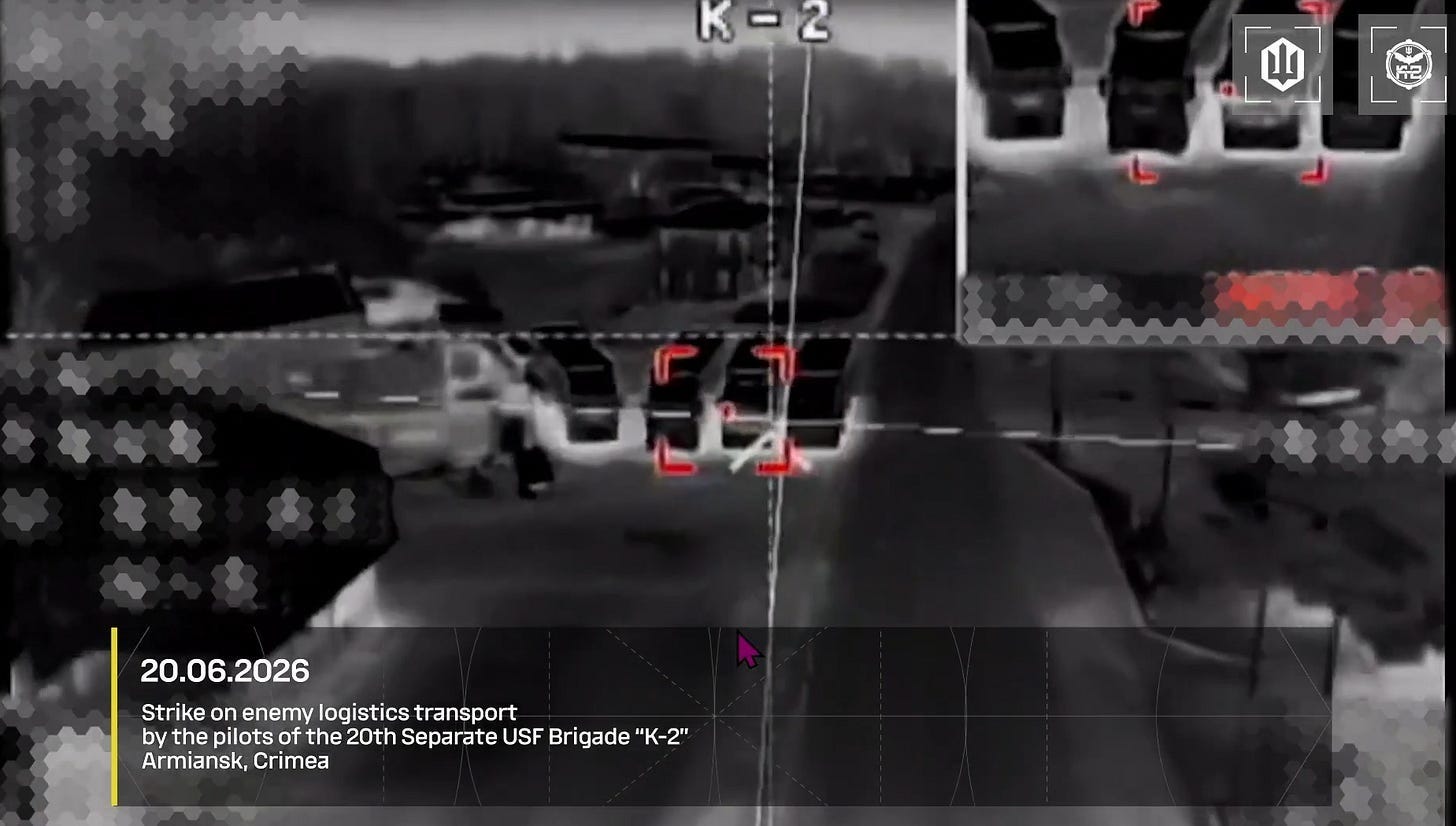
What Ukraine has done is create long delays. The delays slows the rate of Russian supply and it also keeps the Russian trucks in the ‘kill zone’ longer. The kill zone is the area where Ukrainian mid-strike drones are patrolling, focusing primarily on highways and choke points, such as crossing sites, with some attention paid to secondary roads. The longer the trucks stay in the kill zone, the greater chance there is to detect and attack them. Sometimes multiple trucks are delayed at a crossing while a pontoon bridge is being repaired or a ferry takes a few across at a time. Sometimes trucks are delayed waiting for a single-lane crossing to be cleared by trucks approaching from the other side. If Ukrainian drones are nearby they can eliminate several trucks.
Logistics and the attack on logistics are persistent operations and another form of attritional warfare.
The Status of Crossings
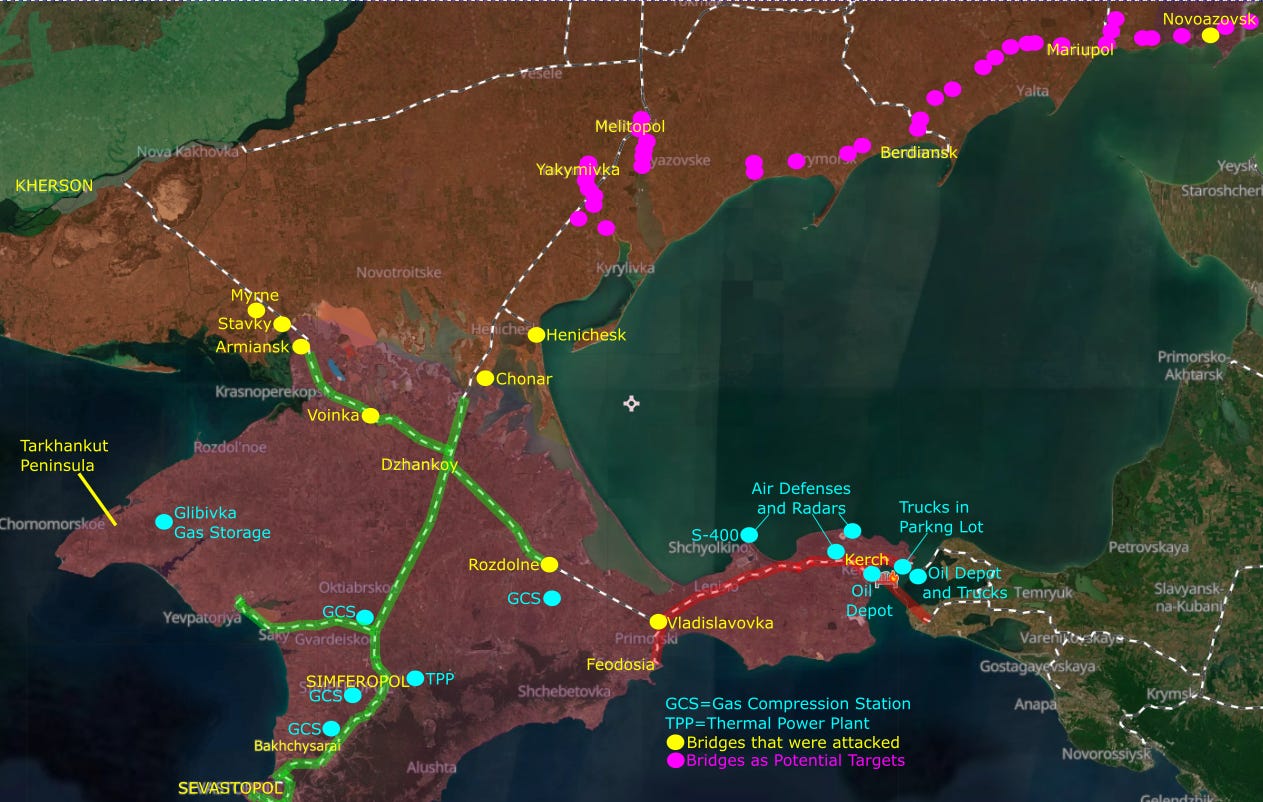
The Promoina Strait bridge at Henichesk was not destroyed, but Ukraine created three holes in the bridge. Passenger cars are still using the bridge as a single lane, but trucks are not.
Russia created ramps leading to a pontoon bridge. The pontoon bridge has been attacked and repaired at least once. This delays the trucks but does not block them. The pontoon bridges are a single lane and the trucks on each side have to alternate when crossing. While on the bridge the trucks need to be spaced out. As of 19 June, the pontoon bridge was reported abandoned by trucks, probably because of additional attacks. Subsequent images showed trucks using the bridge.
The crossing certainly has not been abandoned. Russia is constructing earthworks over the strait in order to build a bridge that is more durable than a pontoon bridge and cheaper and easier to repair than a concrete or pontoon bridge. There is no tidal action in the Sea of Azov because it is the shallowest sea in the world and there is a constant outflow of water into the Black Sea. Water movement between the Sivash lake and Sea of Azov depends on the direction of the wind. Because the Russians are building it, the earthen embankment may be completely solid without a passage for the wind-driven waters. Higher levels of explosives would be needed to destroy the embankment, and any surface damage would be repaired with earth and whatever is used for the surface, possibly crushed stone.
If Ukraine decides to attack the earthen road, it could delay repairs by attacking the dump trucks and other equipment needed for repairs. This equipment could be hidden inside Henichesk, so the best chance to damage or destroy it might be during the construction or repair of the road.
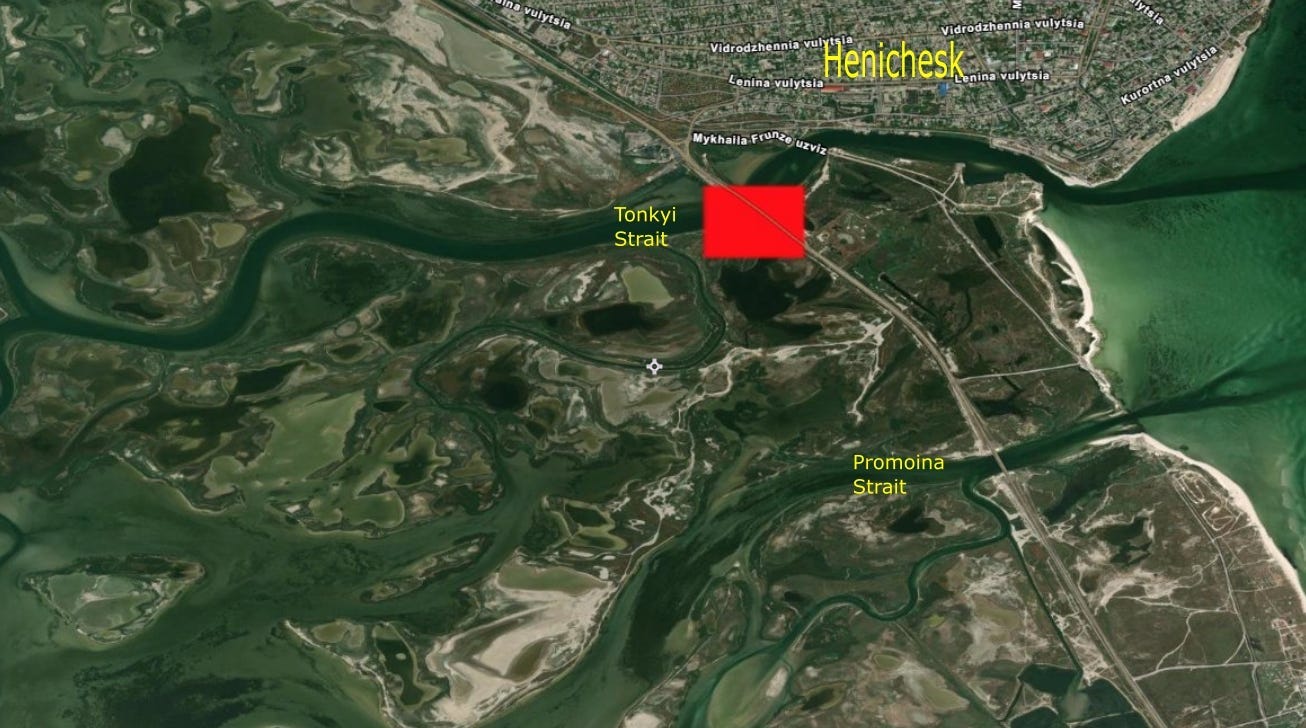
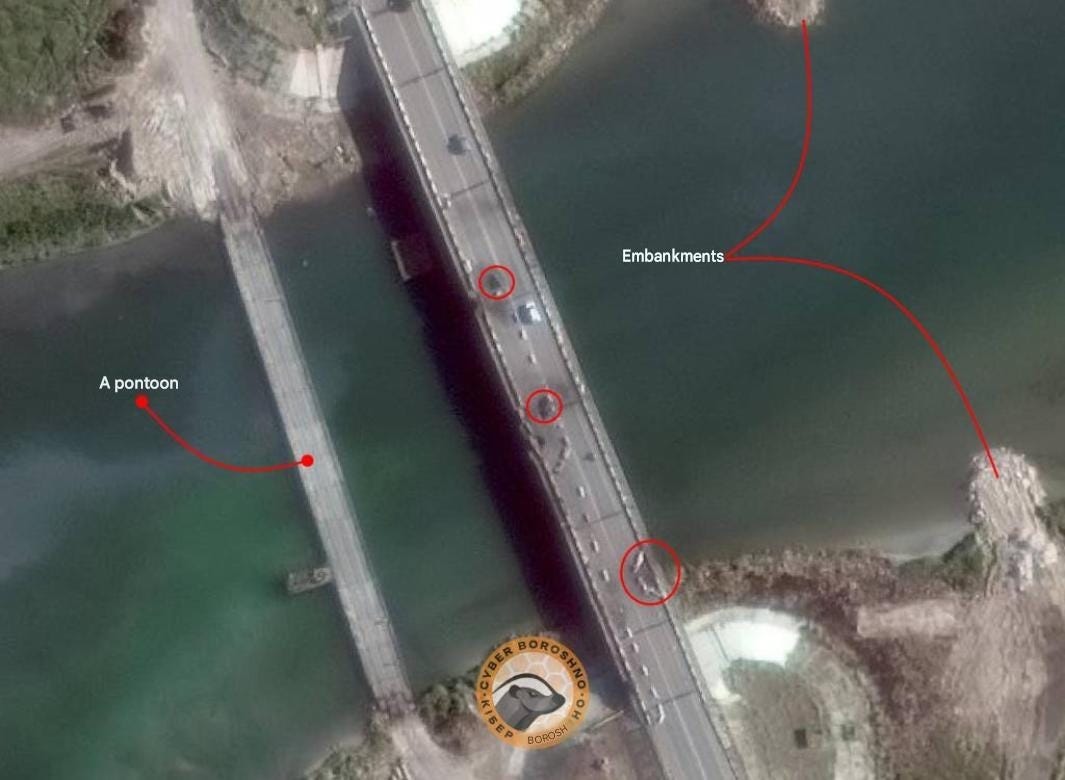
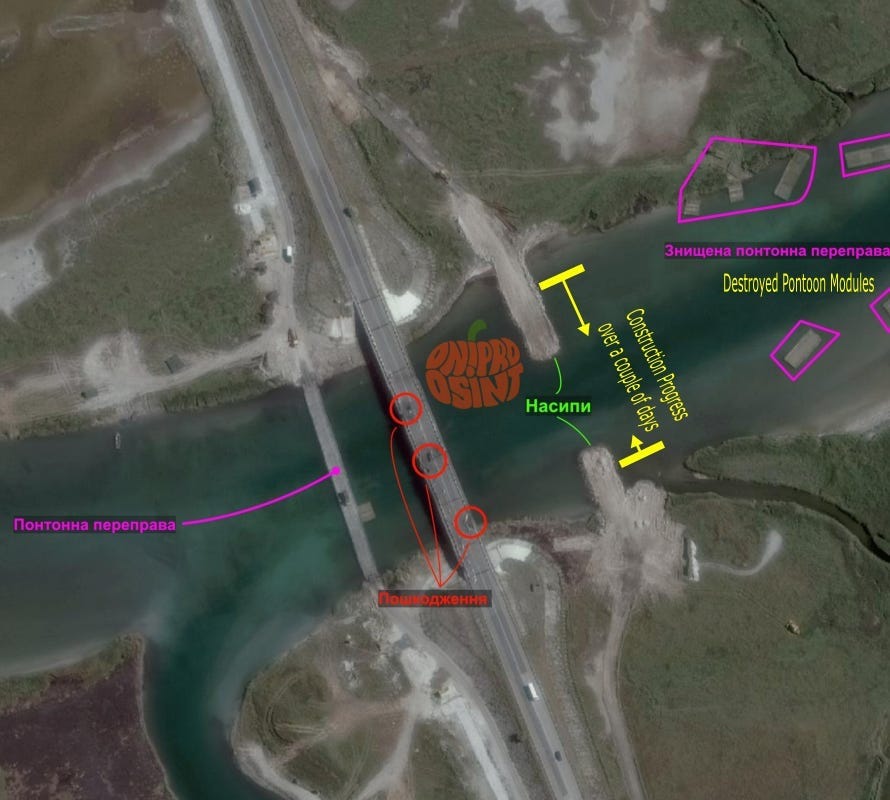
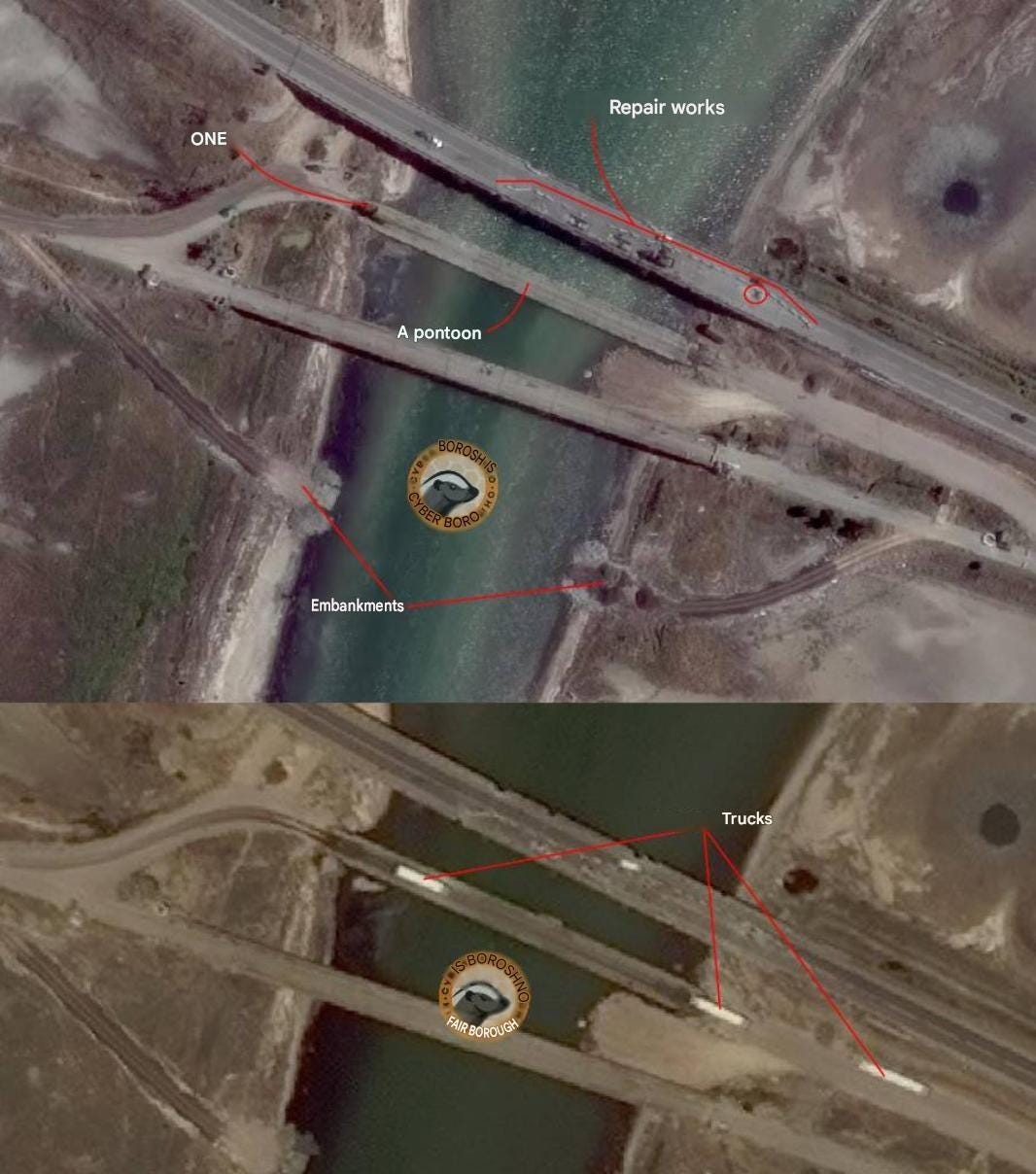
At Chongar, both the old and new highway bridges are damaged. The new highway is being repaired and is used by civilian cars only. Both trucks and civilian traffic are using a pontoon bridge in the middle. Embankments for an earthen bridge are being built.
At Armiansk, the old and new highway bridges and the railroad bridge are damaged. A new earthen bridge was built across the dry canal.
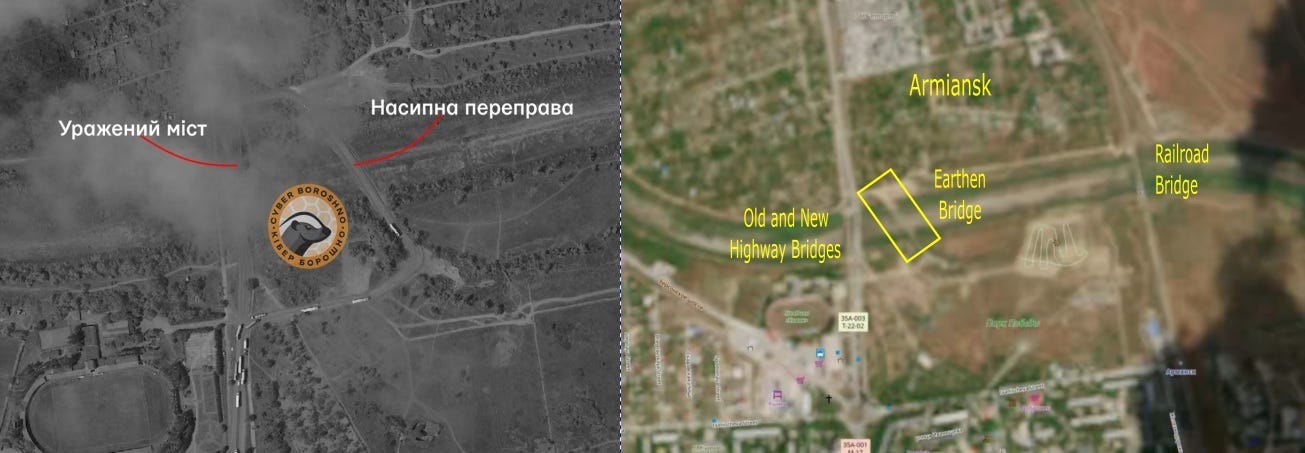
Trucks that wait to cross have been attacked several times.
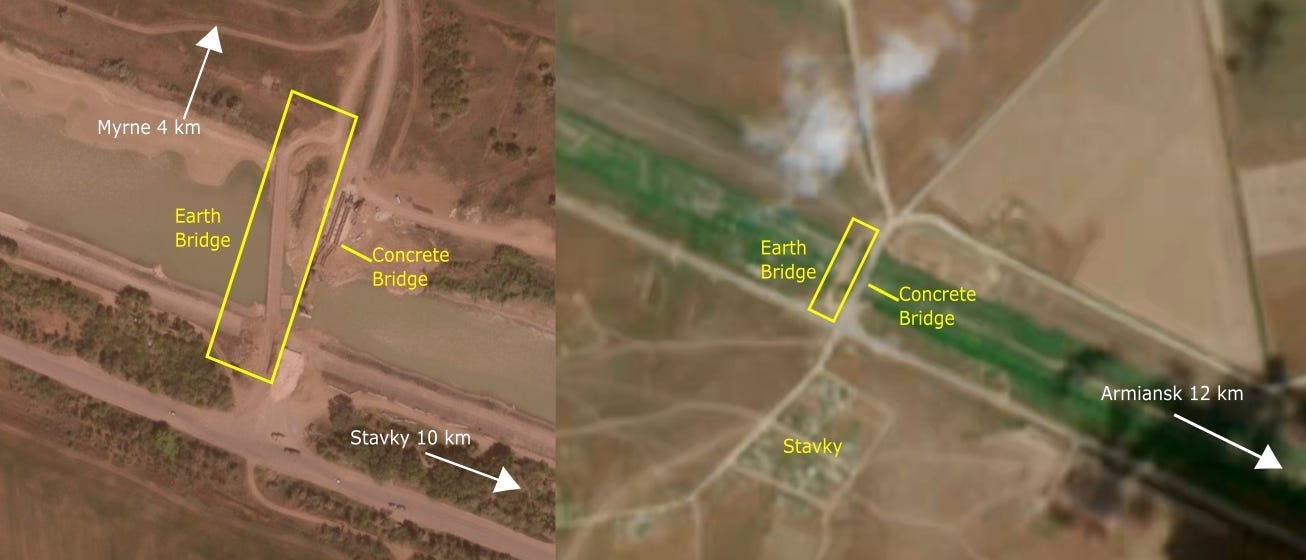
At Stavky, 12 km from Armiansk, an earthen bridge was built in the dry canal to replace the damaged concrete bridge. The bridge south of Myrne was attacked until it was destroyed. There is some water in the canal at this location but the earthen bridge is already built.
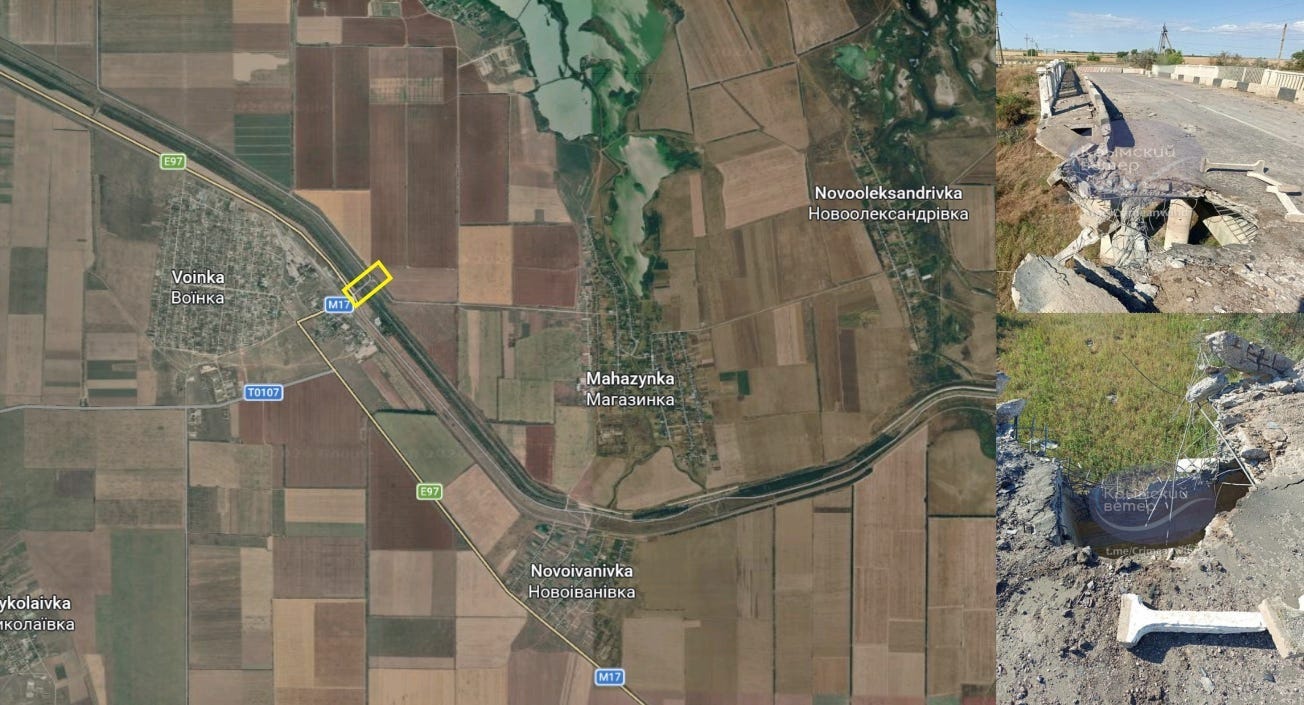
37 km southeast of Arimansk, another bridge on the North Crimean Canal was damaged at Voinka. If the crossing at Armiansk is impassable then trucks could have driven further south and crossed the canal here.
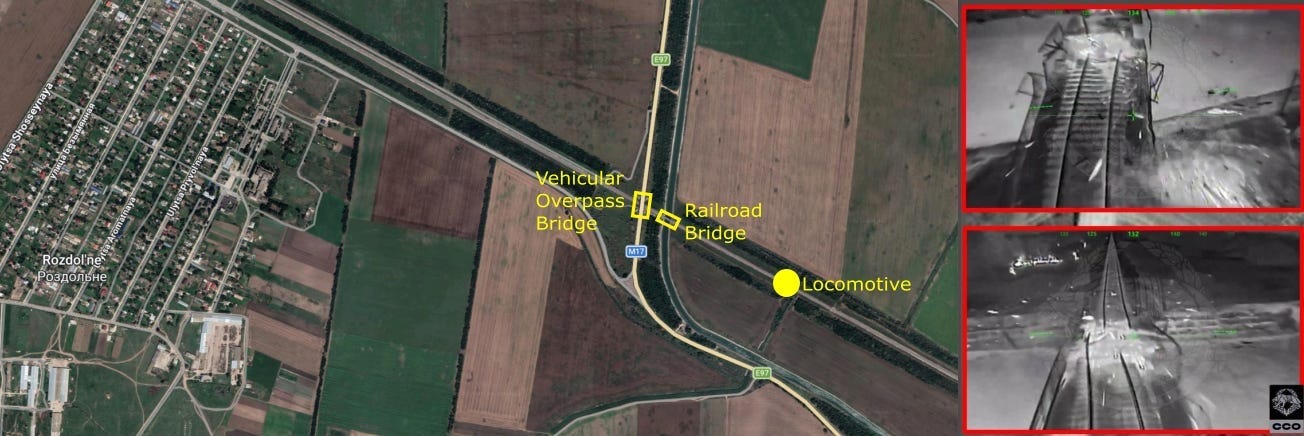
200 km from the front lines, a railroad bridge, a vehicular bridge that passes over the rail line, and a locomotive were attacked at Rozdolne. The extent of damage to the overpass is unknown.
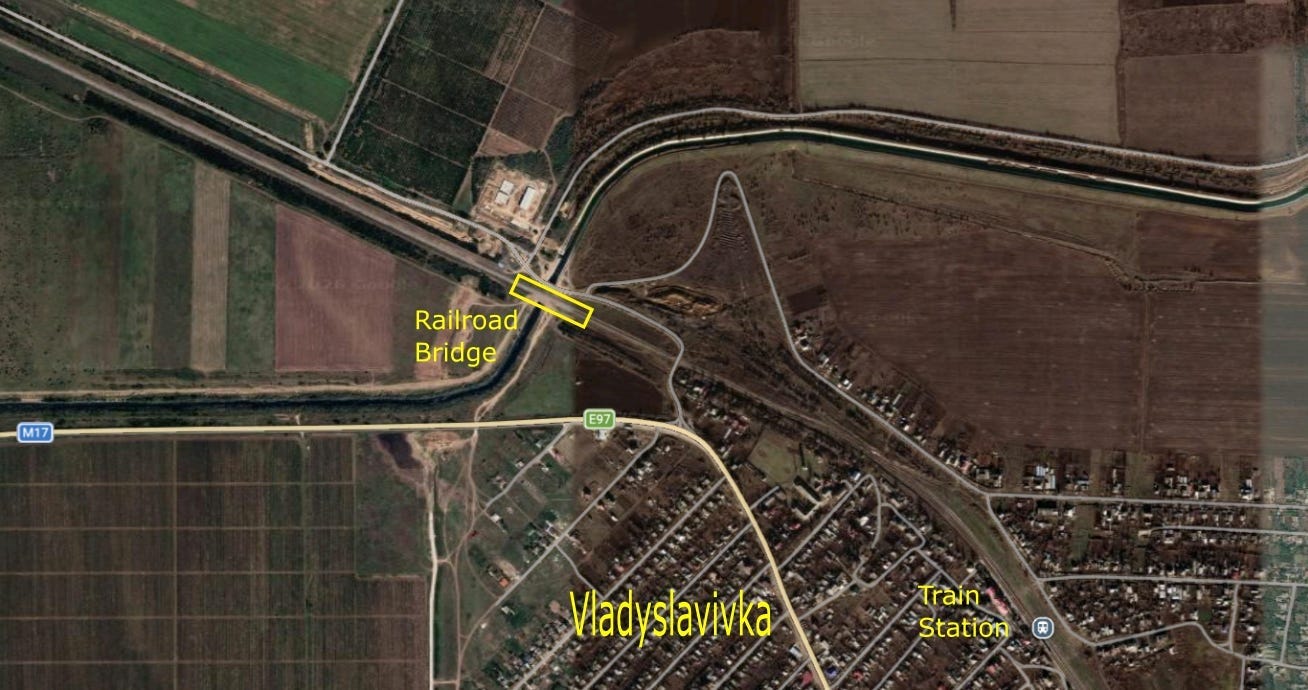
235 km from the front lines, the railroad bridge and train station at Vladyslavivka were attacked. With the severe damage of this bridge, trains coming from Kerch are unable to travel past Vladyslavivka. Since the railroad bridge at Chonar is also destroyed, most of Crimea cannot be reached by train. And since railroad bridges cannot be easily repaired or built, rail traffic into Crimea is blocked.
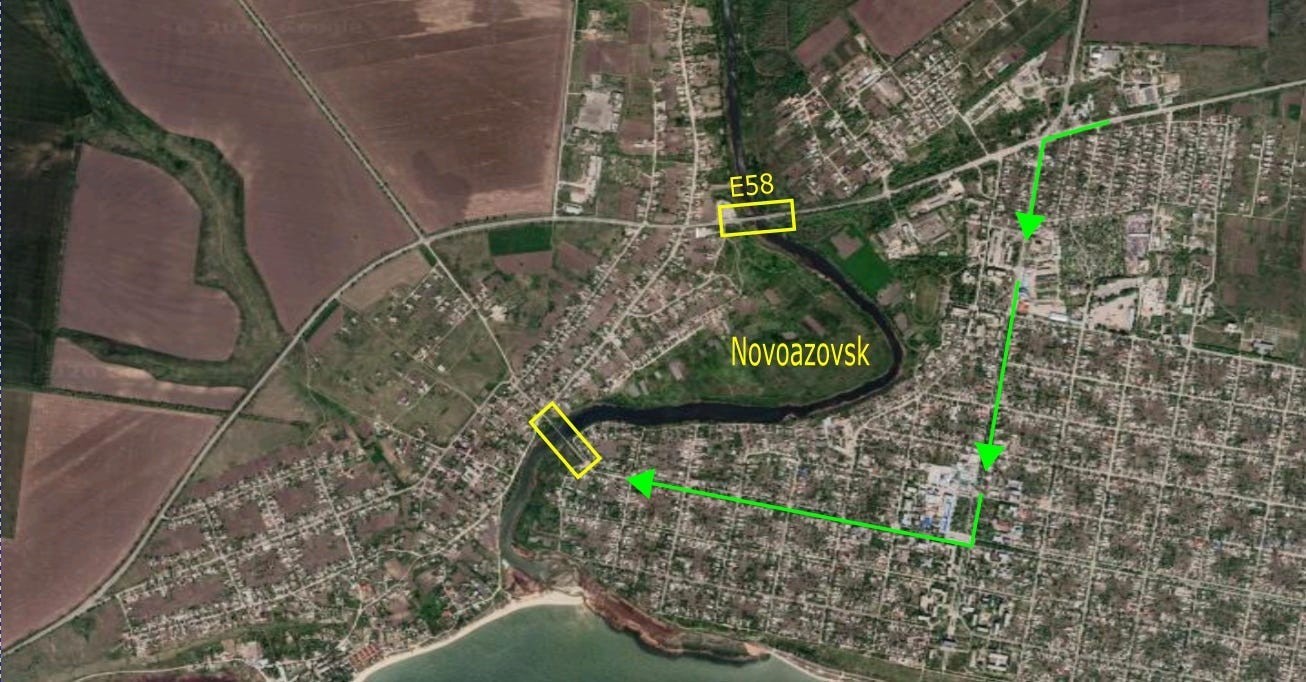
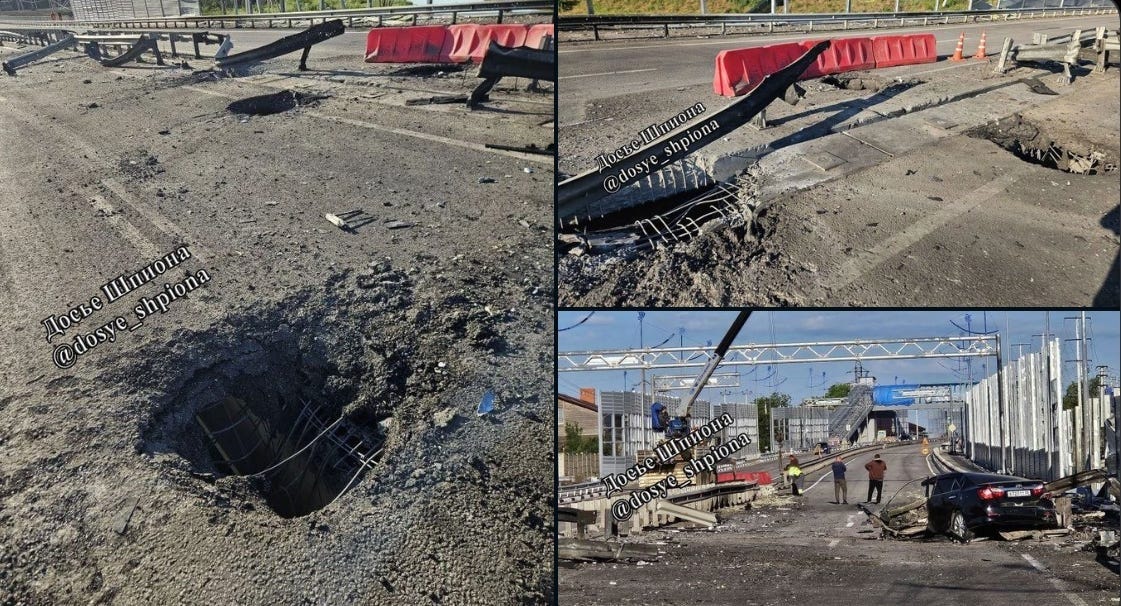
This campaign to destroy bridges is not limited to the isolation of Crimea. The E58 highway bridge in Novoazovsk was damaged. There is another bridge only one kilometer away that is still intact. Trucks now have to divert through the city to cross the river. There are no traffic signals in Novoazovsk, but the local bridge is only a single lane, so the crossing has to be coordinated.
Slowing down and navigating the traffic might only take another 10 minutes, but the E58 highway is the major route into Ukraine from southern Russia, and from there the trucks travel to Huliaipole, Melitopol, Novakakhovka and Crimea, among other places. It doesn’t matter where the destination is. All traffic using E58 from Russia will be delayed 10 minutes. A 10 minute delay for one truck means little, but when a thousands of trips are delayed for a few minutes it adds up when combined with other delays.
One of those factors is that each delay and detour consumes more fuel. This means that trucks will have to stop and refuel more often, which takes time. And with Ukrainian long-ranged drones slowly eroding Russia’s capacity to make fuel, at some point in time it might mean that there isn’t enough fuel to move all the supplies that are needed.
According to a report, passenger car traffic is limited to one lane on the highway bridge but trucks are being diverted to the local bridge which seems to be able to handle the weight. If a particular truck and its cargo is too heavy for the bridge, or if the bridge is damaged at some point, the next bridge is 3 km to the north and it probably can handle the weight, but the road system would create a 14 km detour, which might be a 20 minute delay.
The Novoazovsk E58 bridge was only damaged, not destroyed. Several holes a meter wide or less were created. With careful navigation, they could probably be avoided, but one of the holes managed to eat a car. On top of that, heavy truck loads put stress on a bridge under normal conditions. Stressing a bridge that has already been damaged adds some level of risk.
Potential Operations for Vehicular Bridges
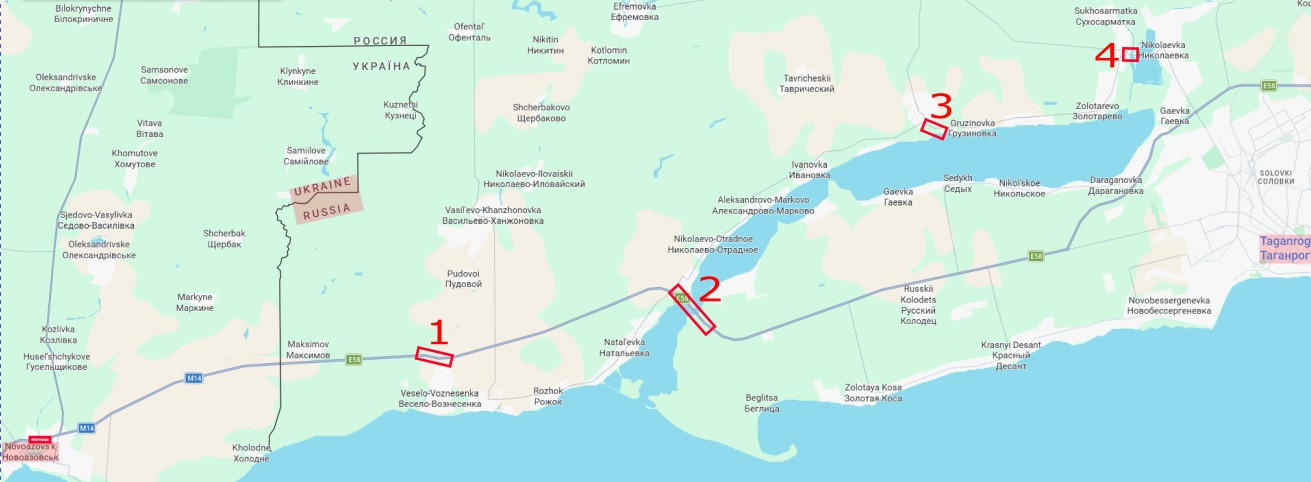
Attacking the bridge at Novoazovsk was good, but attacking three bridges between Taganrog and Novoazovsk would be even better. It would be Russian infrastructure, it would disrupt traffic on the E58 from an even longer distance, and it would spread Russian military resources over a wider area. The bridges are only 160-170 km away from the front lines so they are well within the range of the mid-strike drones.
Looking at the Google Maps view of Bridge 1, even one drone would cause significant damage to the bridge. The nearest detours are even smaller bridges 3 km to the south and 4 km to the north and signs would need to be erected to direct the traffic. The southern detour would add 7 km to the trip and a single drone knocking out that bridge would eliminate the detour. The northern detour would be over dirt roads that would reenter the highway here. 10-20 minutes would be added to the trip if the trucks did not get lost. The volume of traffic with heavy loads would take a toll on the dirt roads, especially when it rained, so Russia would have to improve the roads.
Bridge 2, over the inlet, is an obvious choice. The only detour from this bridge is the secondary road along the northern side of the inlet and a single drone on Bridge 3 would eliminate that route. The only detour around Bridge 3 would be a 50 km trip on secondary roads or if Russia built a 1400 meter road (due north) to connect to secondary roads to create a 5 km detour.
If Bridge 4 is damaged or destroyed the next detour would add 15 km on secondary roads to the north. That fifth detour bridge is part of a narrow road that barely supports two-way traffic in some places but not others. A sixth detour bridge would add 5 km to the trip, may not support the weight of a heavy load and cannot support two-way traffic. The next bridge after that adds another 5 km and returns to the same narrow roads.
If just these four bridges were destroyed, an extra 30 km of secondary and tertiary roads would be added to the route that would take an extra hour to travel. Extending a trip for each and every truck by an hour slows the resupply rate and burns more fuel.
If those four bridges are disabled, Russia would have to endure that extra hour of detours or reroute logistical traffic near Donetsk on the E50 highway or through Avilo-Uspenka. The area around Donetsk is heavily patrolled by Ukrainian mid-strike and FPV drones. Traffic can be routed through Starobesheve to try and avoid the drones, but that rural settlement is 100 km from the front and there’s been an instance of an FPV drone flying 103 km to destroy a truck.
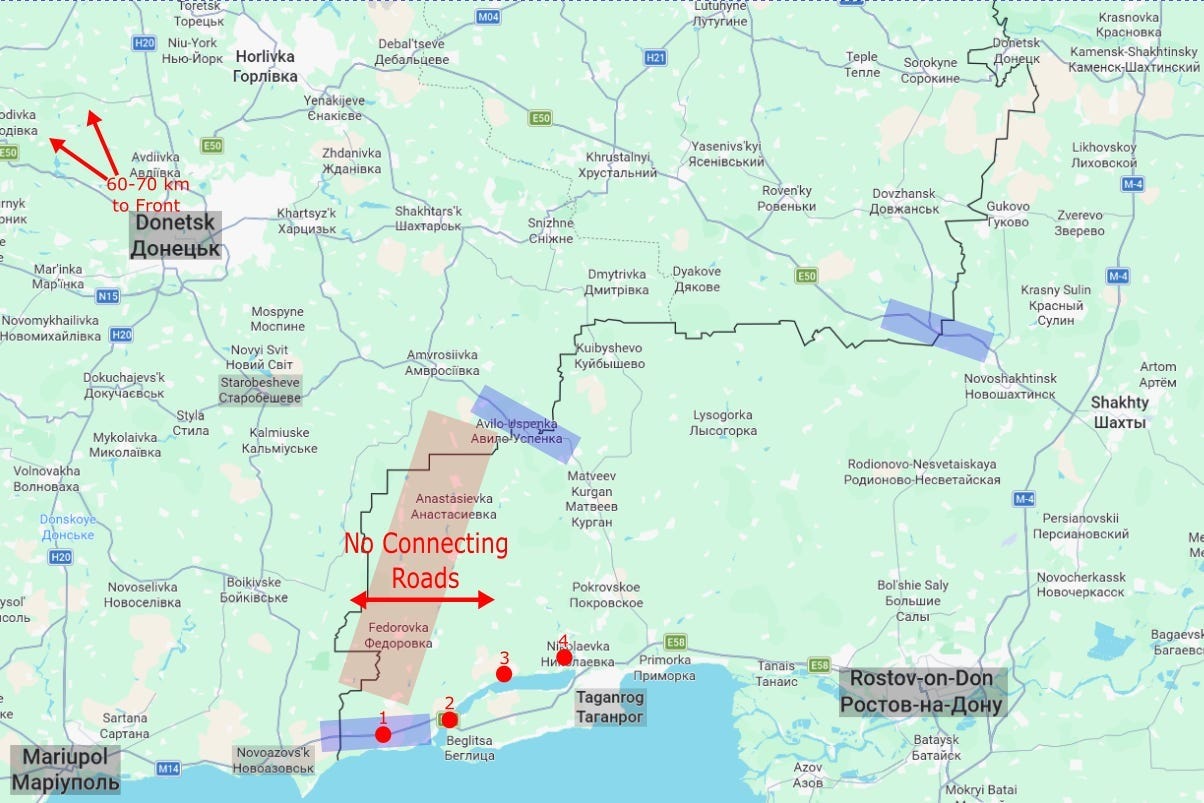
Ukraine has many options to put more pressure on Russian vehicular logistics. If traffic between Taganrog and Mariupol is delayed or blocked, it would impact Russian operations in Donetsk, Zaporizhzhia, Kherson and Crimea.
Potential Operations for Rail Bridges
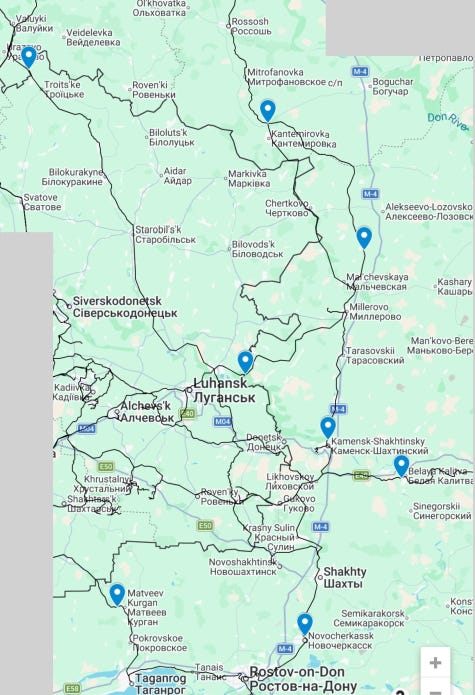
It is much more efficient to move supplies by train. These eight railroad bridges, plus the Kerch bridge, all cross a river. If they are destroyed, Russia will have no rail access into the temporarily occupied territories.
Power Infrastructure
In addition to attacking bridges, Crimea’s only natural gas storage site and four gas compression stations were attacked and heavily damaged, if not destroyed. There have already been widespread power outages in occupied Kherson and Crimea, but a power plant near Simferopol was attacked and burned for a couple of days. This provides power to the grid that services Dzhankoi, a key rail and logistical hub, and all the radars located on the Tarkhankut peninsula. Part of Crimea is without power and the water supply pumping stations there have stopped working.
Power in Crimea has been unreliable, and the attack on the power station puts additional stress on the electrical grid. Gas generators provide backup power for train signals and military units but the gas storage and distribution networks have been attacked. This will make it difficult for the trains trapped in Crimea to run and for military units to function.
Sea and Air Transport
Russia does not have any operational ships that could carry heavy loads of cargo or railway cars as the last of them was knocked out in April. They tried to use smaller ferries to carry trucks but after three were attacked and damaged at the same time, ferry operations were suspended.
Russia has 368 Antonov transports. 143 cannot fly due to maintenance issues. Designed in Ukraine, they cannot get parts. Russia estimates that somewhere between December 2026 and May 2027, none of the Antonov fleet will fly.
They have about 110 Il-76’s and build around 7 a year. Russia does not have the aircraft to provide the amount of supplies needed or the logistical infrastructure to operate and sustain an airlift. Any aircraft that landed at an airport would become a target while it was unloaded and refueled. Any attempt at continuous operations would render most of the fleet inoperable in a matter of time.
Summary
Russia can still operate trains that are marooned within Crimea as long as there is fuel, electricity for signaling and the locomotives are not destroyed. Trains from Russia can cross over the Kerch bridge and travel as far as Fedosia. There are no detours around railroad bridges for trains, and railroad bridge repairs have to return the bridge to its original strength. Ukraine can block all trains from entering the occupied territories and force Russia to rely entirely on trucks for logistics.
The highway bridge at Novoazovsk can’t be used until it’s repaired. This should be the first of many attacks on bridges along the E58 highway. These attacks will impact Russian operations throughout the south.
Russia has shown they will fight to keep the crossings into Crimea open. The pontoon bridges were their first response, but after persistent Ukrainian attacks they started building earthen roads across empty canals and watery lagoons alike. Time will tell if Ukraine has a response to them. Even if Ukraine does nothing, Russian transportation is permanently slowed. The accumulated delay in the kill zone will lead to the destruction of more trucks.
Convoys protected by mobile fire teams provide some level of protection, but they take time to form and are not as efficient as trucks moving on their own to their different destinations. Ukraine has already fired rockets from drones. It would be interesting if they developed a way to accurately engage mobile teams from a distance before attacking the convoy. If the air defense escorts are eliminated then trucks in a convoy would be more at risk than if they were driving alone.
There are already fuel shortages reported in occupied Donetsk for both the civilians and military. Military personnel attempted to purchase fuel in Rostov but gas station employees told them they were not allowed to dispense fuel into barrels but they were allowed to fill 50 liter canisters. A local describes the availability of gas.
Russia is an army that expends massed personnel and massed firepower. The rate of supplies must equal the rate of expenditure on the front lines or the rate of expenditure will be reduced. Delays and destruction reduce the rate of supply.
This is a war of attrition and Russia is losing the logistical war because Ukraine has air superiority in Russia’s rear areas. If Ukraine maintains air superiority Russia will continue to lose the logistical war.
Thanks for a detailed and informative analysis. Explaining why this will take some time, but this obviously a situation of cascading effects. First things get delayed a little, then more and then stopped. And all small effects will add up to problems. But we should unfortunately not underestimate Russian ingenuity and will to find solutions either. Can Ukraine maintain air superiority? We shall hope and pray and see. Of course, the effects of the long strikes campaign fuels into this, gasoline becomes more and more difficult to attain, air-defense must be put somewhere and cannot be put everywhere…
Excellent detail Don, thank you 👍